


Share This Article
Most business owners don’t have a reading problem; they have a selection problem. Hundreds of business titles launch every year, but many repeat the same advice in new packaging.
So this list is short and deliberate. These are the best business books in 2026 for owners facing three pressures at once:
- AI that changes how work gets done,
- risk that arrives without warning, and
- growth that strains the team.
None of them was published in 2026. However, each has held up over time, and each answers a question you are probably asking right now.
The Best Business Books in 2026 for Owners Who Want Clarity
Each pick below comes with one action you can take this week. Reading without acting is just entertainment.
1. Scaling Up by Verne Harnish: Growth Without Chaos
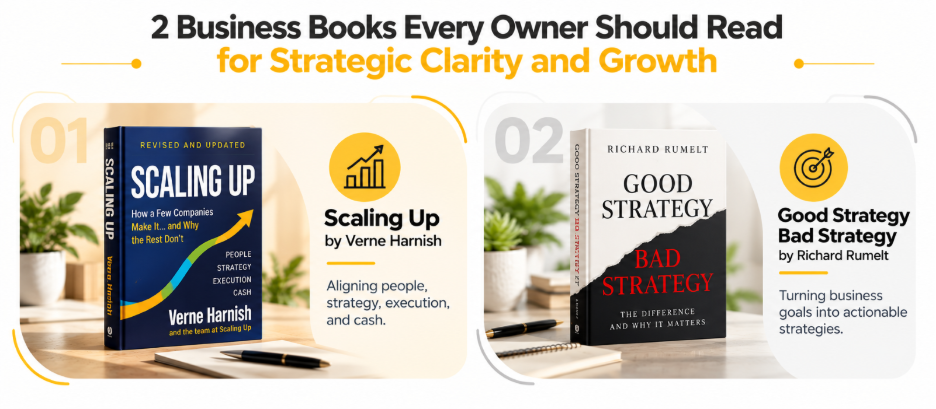
Harnish builds growth around four decisions: People, Strategy, Execution, and Cash. Most owners are strong in one and shaky in another. That’s why this book gives you practical tools to find the weak spot. These include the One-Page Strategic Plan and a meeting rhythm built on the Rockefeller Habits. It earns its place among the best business books in 2026 because it reads like a field manual. Among business growth books, few treat cash as seriously as vision.
Apply it: Rate your company on the four decisions, then fix the weakest one first. The Quick Assessment is a fast way to begin.
2. Good Strategy Bad Strategy by Richard Rumelt: A Filter for Fluff
Rumelt argues that most “strategy” is a wish list. A real strategy has a kernel with three parts: a diagnosis of the challenge, a guiding policy, and a set of coherent actions. If your plan has bold targets but no diagnosis, it is a goal, not a strategy. Few business strategy books cut through vague planning this quickly.
Apply it: Write your diagnosis in two sentences. If you cannot, you are not ready to write the plan.

3. Co-Intelligence by Ethan Mollick: Working With AI Daily
Mollick, a Wharton professor, wrote for people who use AI, not people who build it. He offers four principles.
- Invite AI into your work (always invite AI to the table).
- Stay human in the loop (be the human in the loop).
- Treat it like a person, but tell it what kind of person.
- And assume that the tools we’re currently using are the weakest you will ever use.
Start here if AI still feels abstract. It belongs among the best business books in 2026 because it pushes you to experiment, not just observe.
Apply it: Pick one repeating task, such as drafting proposals. Test AI on it for two weeks. Note where it helps and where it fails.
4. Power and Prediction by Agrawal, Gans, and Goldfarb: AI at Company Level
Mollick covers daily use. However, these three University of Toronto professors cover the bigger shift. Their argument is simple. AI makes prediction cheaper, but the largest gains come when you redesign the whole system around it. Dropping AI into one step of an old process gives small wins. They call these point solutions. But rebuilding the workflow is a system solution. This is one of the best business books in 2026 for owners who plan beyond quick experiments.
Apply it: Map one workflow from start to finish. Ask which decisions would change if forecasts were nearly free.

5. Antifragile by Nassim Nicholas Taleb: Risk as a Design Problem
Most business books treat risk as something to reduce. Taleb sorts things into three types. Fragile things break under shocks, robust things resist them, and antifragile things improve because of them. His barbell idea is useful. Keep most resources very safe, and place a small share in high-upside bets whose losses you can survive. He also values optionality, meaning cheap choices with large potential payoffs. It remains one of the best business books in 2026 for thinking about risk.
Apply it: List your three biggest dependencies, such as one customer, one supplier, or one key person. Reduce the one that could sink you.
6. Thinking in Bets by Annie Duke: Better Decisions Under Uncertainty
Duke is a former professional poker player. She warns against “resulting,” judging a decision by its outcome instead of the thinking behind it. A good decision can lose while a poor one can win. Owners who confuse the two repeat luck and punish sound judgment. She also urges you to state beliefs as degrees of confidence, not certainties. That habit alone earns it a spot among the best business books in 2026.
Apply it: Before your next big call, write down your confidence as a percentage and list your key assumptions. Review both after 90 days.
7. The Hard Thing About Hard Things by Ben Horowitz: Honest CEO Leadership
Horowitz co-founded the venture firm Andreessen Horowitz. Earlier, he was CEO of a software company during the dot-com crash. He offers no formulas, and that is the point. He separates peacetime and wartime CEOs. Peacetime leaders focus on expansion and culture. Wartime leaders must act fast under real threat. Among CEO leadership books, it is unusually frank about layoffs, bad hires, and sleepless stretches.
Apply it: Decide whether your company is in peacetime or wartime today. Then check whether your leadership habits match.
How to Read Them Without Losing Months?
Do not read all seven in order. Choosing gets easier when you start with the pressure that hurts most. If AI feels urgent, open Mollick. If cash or team alignment is slipping, open Harnish. If surprises keep landing, read Taleb and Duke.
Read each book with one live problem beside you and end with a single decision. Then share it with your leadership team and discuss one chapter per meeting.
Remember, ideas become results through application. That’s why our team at Success Alchemists runs a one-day Basecamp workshop on the four pillars of People, Strategy, Execution, and Cash. If you want guided help, get in touch.
FAQs
1. What are the best business books in 2026 for a small business owner?
Start with Scaling Up for growth systems and Good Strategy Bad Strategy for clear thinking. Add Co-Intelligence if AI is your current concern.
2. Are the best business books in 2026 all new releases?
No. These seven were published between 2011 and 2024. They made the list because their ideas apply directly to today’s AI, risk, and growth pressures.
3. Which book should I read first if AI worries me?
Read Co-Intelligence first. It is practical and personal. Then move to Power and Prediction for the company-level view.
4. Which are the strongest business growth books on this list?
Scaling Up is the most direct. The Hard Thing About Hard Things adds the leadership side of growing under pressure.
5. What are the best leadership books in 2026 for a first-time CEO?
Start with The Hard Thing About Hard Things and Scaling Up. Add Thinking in Bets to sharpen how you make decisions.