

Share This Article
There’s a pattern that repeats itself quietly in boardrooms. When you’re a founder-CEO, you know every square inch of the company. You’re the one who dragged it from zero to a massive revenue milestone. But suddenly, it starts feeling like the walls are closing in. Decision fatigue sets in. Growth plateaus. The strategies that worked brilliantly at ₹20 crore start losing their grip at ₹80 crore.
What usually follows is either a costly hiring spree, a restructuring exercise, or a deliberate search for an executive coach.
But here’s the problem. The coaching industry is crowded, largely unregulated, and full of practitioners who speak the language of transformation without having ever run a real business. Choosing the wrong coach doesn’t just waste your time and money; it can cost you momentum you can’t afford to lose.
If you’re serious about growth strategy consulting, this guide is for you.
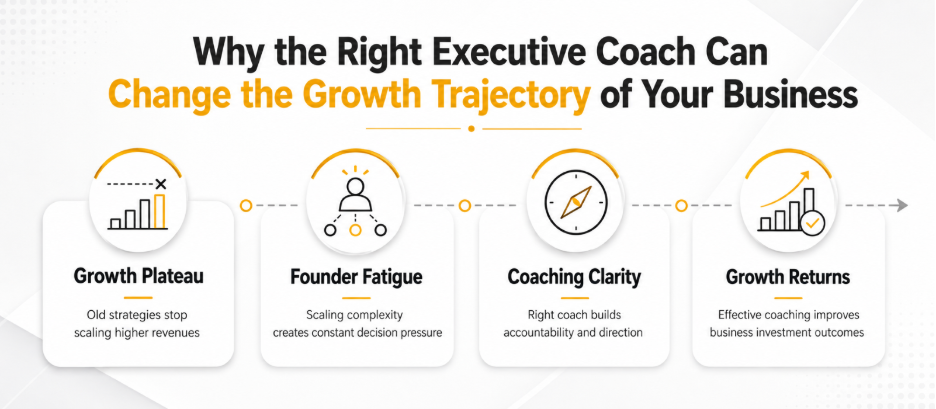
Why the Right Coach Changes Everything (and the Wrong One Changes Nothing)?
Growth strategy consulting, when done right, is one of the highest-ROI investments a CEO can make. A study by the International Coaching Federation found that 86% of companies reported recouping their coaching investment, with many reporting returns of 7x or more.
The distinction matters more than most CEOs realize.
A therapist helps you process your past. A mentor shares what worked for them. A consultant tells you what to do. An executive coach creates the conditions in which you discover what you already know, and then holds you ruthlessly accountable to acting on it within a structured framework.

The 7 Criteria That Actually Matter When Choosing an Executive Coach
1. They’ve Operated in Complexity, Not Just Coached Through It
The most important criterion is whether your potential coach has navigated the kind of operational complexity you’re living through. Coaching credentials alone don’t tell you this. Ask pointed questions: Have they run a P&L? Have they scaled a team through a growth inflection? Have they managed multi-city or multi-country operations?
At Success Alchemists, our growth strategy consulting team brings decades of actual operational experience across telecom, technology, banking, and manufacturing.
2. They Work Within a Proven, Structured Framework
One of the most common mistakes CEOs make is hiring coaches who work entirely on intuition and conversation. While personal insight is valuable, sustainable business growth requires structured intervention across multiple dimensions of the business.
The Scaling Up framework is a globally validated methodology that has been applied across 100,000+ companies worldwide.
3. Their Clients Look Like You (In Two to Three Years)
Ask for case studies or references from clients who were at your stage when the engagement began. A coach who’s only worked with early-stage startups just won’t have the muscle memory for a ₹75 crore company trying to hit ₹200 crore. The friction points are completely different.
Growth strategy consulting at the executive level requires familiarity with the complexity of mid-market scale, not just the early hypergrowth.
4. They Prioritize Execution Over Reflection
High-performing CEOs don’t need more time to think. They need sharper clarity on which three things to do next, and someone holding them accountable. Your coach should hold you to commitments, track progress between sessions, and challenge you when you’re rationalizing inaction.
If your first few coaching conversations feel like therapy sessions, that’s a signal worth paying attention to.
5. They Understand How to Build a Leadership Team, Not Just Coach You
The real leverage in growth strategy consulting isn’t just the CEO; it’s how that shift fundamentally changes the entire leadership team. A great coach helps you build a team that can run the business without you needing to be in the room every single day. This is the difference between personal development and strategic business growth.
Our framework targets the four pillars of People, Strategy, Execution, and Cash, which means coaching happens at the system level, not just the individual level.
6. They Challenge Your Business Model, Not Just Your Mindset
A lot of coaches stay in their comfort zone. But for CEOs in high-growth environments, the business model itself often needs to be scrutinized. Are you pricing correctly? Are you chasing revenue at the cost of profitability? Are your growth levers actually scalable? A coach worth their retainer should be willing to go there.
7. Chemistry Is Real — and Non-Negotiable
None of the above matters if you don’t genuinely trust and respect the person across the table. This isn’t about comfort. In fact, the best coaching relationships are deeply uncomfortable. But there has to be a foundation of psychological safety that encourages radical honesty. Therefore, ask for a trial session before committing to a long-term engagement.
Red Flags to Watch For
Choosing an executive coach for CEOs requires the same due diligence you’d apply to any senior hire. Watch for these warning signs:
They avoid specificity. If a coach can’t tell you precisely what the engagement will look like, what milestones you’ll track, and how success will be measured, you’re looking at an open-ended commitment with no accountability.
They promise transformation without timelines. Real change in a business context happens in defined cycles — quarterly sprints, annual priorities, 90-day execution plans. A coach who speaks only in the language of “journey” and “process” may not be commercially oriented enough for your needs.
They have no skin in your outcomes. Growth strategy consulting wins when you win. If there’s no mechanism for measuring whether the engagement actually moved the needle, you should be skeptical.
They haven’t scaled anything themselves. This is perhaps the bluntest filter, but it’s a fair one. You can’t coach a founder past the ₹100 crore mark using a textbook. That takes real-world intuition. Academic knowledge of scaling frameworks is a poor substitute for scar tissue.
The Questions to Ask Before You Sign
Before engaging any executive coach, run through these questions:
What frameworks do you use, and what evidence supports their effectiveness at my stage of growth?
Can you walk me through a specific engagement where a client went from your starting point to a measurable growth milestone?
How do you handle a coaching relationship when the client isn’t following through on commitments?
How do you work with the leadership team, not just the CEO?
What does success look like at 6 months, 12 months, and 24 months?
How do you separate coaching from growth strategy consulting, and when do you blend the two?
What is your approach to helping leaders build a business that runs without them in the room?
The answers to these questions will tell you more than any credential or testimonial.
The Real Decision
At the end of the process, choosing an executive coach is fundamentally a bet. You’re betting that spending time in structured accountability will generate a return that exceeds what you’d achieve. The research and the experience of thousands of CEOs say this bet pays off, but only when the coach is right.
You can take the quick business assessment to understand where your growth gaps actually lie. And remember: the goal isn’t to find a coach you like. The goal is to find a coach who helps you build something that outlasts your daily involvement.
FAQs
1. What is growth strategy consulting, and how does it help CEOs?
Growth strategy consulting helps business leaders identify growth opportunities, improve execution, strengthen leadership teams, and create scalable systems that support long-term business expansion.
2. How is an executive coach different from a consultant?
A consultant typically provides recommendations and solutions, while an executive coach helps leaders develop clarity, make better decisions, and stay accountable for implementing strategic actions.
3. Why is industry experience important when choosing an executive coach?
A coach with real operational and leadership experience can better understand business complexities, growth challenges, and scaling issues that CEOs face at different stages.
4. What frameworks should an executive coach use for business growth?
Effective coaches often use proven frameworks like Scaling Up, which focuses on People, Strategy, Execution, and Cash to drive sustainable growth.
5. How long does it typically take to see results from growth strategy consulting?
While timelines vary, businesses often measure progress through 90-day execution cycles, with meaningful improvements typically becoming visible within six to twelve months.