


Share This Article
Crossing ₹50Cr in revenue changes the nature of a business completely.
What helped a company grow from ₹5Cr to ₹50Cr rarely helps it scale to ₹500Cr. At this stage, businesses face a different level of complexity, strain, and confusion. Teams become larger. Decision-making slows down. Accountability weakens. Culture starts fragmenting across departments. Growth continues, but profitability, clarity, and momentum start slipping.
This is the phase where many CEOs discover a difficult truth: scaling a company is no longer about working harder. It is about building a leadership system that performs without depending entirely on the founder.
The Real Challenges CEOs Face Beyond ₹50Cr
Founder Dependency Starts Slowing the Company
In many mid-sized businesses, the founder remains the center of every major decision.
Sales escalations, hiring approvals, strategy changes, client issues, vendor negotiations, and even operational firefighting continue flowing through the CEO. Initially, this involvement feels productive. Over time, it becomes the biggest scaling bottleneck. This creates:
- Slow decision cycles
- Leadership hesitation
- Operational overload
- Burnout at the top
- Poor succession depth
That’s where CEO coaching helps founders transition from being operational problem-solvers to strategic growth architects.
Leadership Misalignment Quietly Damages Growth
One of the most underestimated scaling problems is leadership misalignment.
At ₹50Cr+, businesses often have competent department heads who are individually strong but collectively disconnected. Sales chase aggressive targets while operations struggle with delivery capacity. HR pushes hiring while finance worries about rising overheads. Marketing drives lead volume while customer success fights retention issues.
Everyone works hard, but not always in the same direction. This creates execution friction across the company.
That’s why CEO coaching focuses heavily on leadership alignment because strategy only works when leadership teams move with shared priorities, shared metrics, and shared accountability.
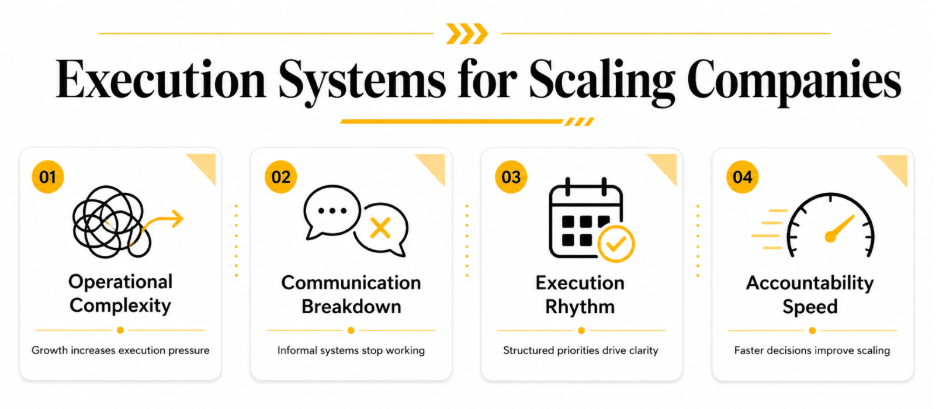
Scaling Businesses Need Better Execution Rhythms
Growth Creates Operational Chaos Faster Than Most CEOs Expect
As companies grow, operational complexity expands exponentially.
What once worked through informal communication now requires structured systems. What once depended on instinct now demands measurable execution frameworks.
Without disciplined execution rhythms:
- Meetings become reactive
- Priorities constantly shift
- Teams lose visibility
- Projects slow down
- Accountability weakens
This is where many CEOs begin feeling trapped inside endless firefighting cycles.
Therefore, CEO coaching introduces structured execution systems that help leadership teams:
- Clarify priorities
- Improve decision velocity
- Create accountability
- Build meeting discipline
- Track execution consistently
The objective is not more meetings. It’s organizational clarity.
Plateaued Decision-Making Becomes a Hidden Risk
Businesses crossing ₹50Cr usually reach a point where old decision-making approaches stop working.
Founders who once trusted intuition now face:
- Multiple business units
- Complex hiring structures
- Large cash commitments
- Expanding markets
- Diverse customer expectations
As a result, decision fatigue affects growth quality without strategic frameworks. Many CEOs experience this silently.
However, CEO coaching helps leadership teams improve strategic thinking under scale pressure. It creates space for reflection, prioritization, and long-term planning instead of constant operational reaction.
Scaling Beyond ₹50Cr Requires Cultural Discipline
Culture Cannot Scale Through Founder Energy Alone
In early-stage businesses, culture often spreads naturally through direct founder interaction. At scale, this stops working.
As teams expand across departments, cities, and leadership layers, culture becomes inconsistent unless it is intentionally operationalized.
This creates:
- Accountability gaps
- Leadership inconsistency
- Talent attrition
- Internal politics
- Reduced ownership mindset
Many CEOs mistakenly believe culture is an HR responsibility. In reality, culture is a leadership execution system.
Strong business coaching for CEOs helps companies define:
- Leadership expectations
- Decision principles
- Communication rhythms
- Accountability behaviors
- Organizational priorities
Scaling companies need cultures that perform under pressure, not cultures that depend entirely on founder presence.
Cash Flow Pressure Increases During Rapid Growth
Revenue Growth Does Not Automatically Create Financial Stability
One of the biggest surprises for growing companies is that higher revenue often creates higher financial stress.
As a result, scaling businesses face:
- Rising operational expenses
- Hiring pressure
- Delayed receivables
- Inventory challenges
- Expansion investments
- Margin compression
Many CEOs focus aggressively on top-line growth while operational inefficiencies quietly damage cash health.
This is why the Scaling Up framework emphasizes cash as a core scaling pillar alongside people, strategy, and execution. CEO coaching helps leadership teams build stronger financial discipline around:
- Cash flow visibility
- Profitability tracking
- Strategic investment decisions
- Operational efficiency
- Financial accountability
Why External Coaching Changes Leadership Performance
CEOs Need a Strategic Perspective Beyond Internal Teams
Most CEOs operate inside high-pressure environments where everyone expects answers from them. However, very few people challenge their assumptions honestly. Internal leadership teams may hesitate to question decisions directly. Employees often filter information upward. Advisors may focus only on financial or operational areas. This creates leadership isolation.
Therefore, an experienced CEO coach provides:
- Objective perspective
- Strategic clarity
- Accountability
- Pattern recognition
- Decision support
- Leadership alignment frameworks
The value is not theoretical advice. The value comes from implementation-focused guidance built around real scaling challenges.
Why Scaling Up Frameworks Matter for Growth-Stage Companies?
The Scaling Up methodology has gained global adoption because it addresses the exact challenges growth-stage businesses face while scaling operations.
It focuses on four critical pillars:
- People
- Strategy
- Execution
- Cash
For CEOs leading companies beyond ₹50Cr, these pillars create operational clarity across the organization.
Instead of scaling through reactive problem-solving, leadership teams build:
- Clear priorities
- Defined accountability
- Strong communication rhythms
- Data-driven execution systems
- Leadership cohesion
This structured approach helps companies scale with greater predictability and operational discipline.
At Success Alchemists, our clients have benefited from practical execution support rather than abstract consulting recommendations.
Because scaling businesses do not need more presentations. They need leadership systems that work in real operational environments.
Final Thoughts
The hardest part of scaling a business is not market competition. It is leadership evolution.
The systems, behaviors, communication patterns, and decision-making styles that built the first phase of growth often become limitations in the next phase.
That is why CEO coaching is a serious strategic investment for growth-stage companies.
The Basecamp Workshop by Success Alchemists helps CEOs, founders, and leadership teams build practical scaling systems around execution, accountability, leadership alignment, and sustainable growth.
If your business is preparing for the next phase of scale, this workshop offers a structured path forward built specifically for growth-stage companies.
To know more about the Basecamp Workshop, get in touch with us!
FAQs
1. What is CEO coaching?
CEO coaching is a structured leadership development process that helps business leaders improve strategic thinking, execution capability, leadership alignment, and scaling performance.
2. Why do companies beyond ₹50Cr need CEO coaching?
At this stage, businesses face higher operational complexity, leadership gaps, execution inconsistency, and scaling pressure that require stronger systems and leadership discipline.
3. How does business coaching for CEOs improve execution?
It helps leadership teams establish accountability systems, execution rhythms, strategic priorities, and communication structures across departments.
4. What are the biggest scaling challenges after ₹50Cr?
Common challenges include founder dependency, cash flow pressure, leadership misalignment, execution gaps, hiring complexity, and cultural inconsistency.
5. What is the Scaling Up framework?
Scaling Up is a globally adopted business growth methodology focused on four pillars: People, Strategy, Execution, and Cash.