

Share This Article
Crossing ₹50 crore in revenue is a major achievement. It signals that the company has found market relevance, operational traction, and a working business model. But scaling from ₹50Cr to ₹200Cr is not a continuation of the same journey. It is a different game altogether.
At ₹50Cr, founder instinct still drives many decisions. At ₹200Cr, instinct alone becomes dangerous.
This stage exposes structural weaknesses that were previously hidden by hustle, founder visibility, and reactive execution. What helped build the business often becomes the very thing slowing it down.
This is where high-level business coaching becomes transformational — not as motivational support, but as a strategic discipline that helps CEOs redesign the company for scale.
The shift from ₹50Cr to ₹200Cr requires operational maturity, leadership leverage, and systems thinking that can sustain accelerated growth without creating organizational chaos.
Scaling Beyond Founder Dependency
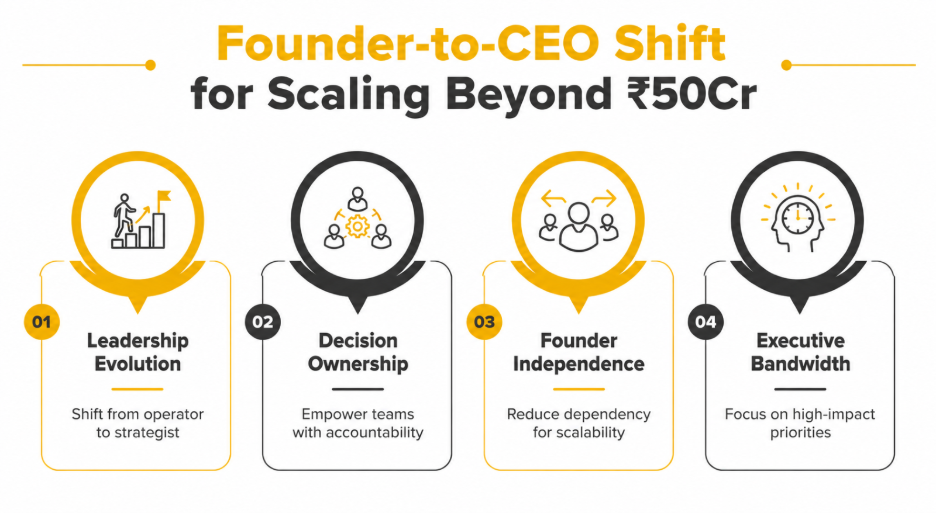
One of the biggest inflection points in scaling up a business is the founder-to-CEO transition.
In many mid-sized companies, founders remain deeply involved in sales approvals, hiring decisions, client escalations, operational reviews, and daily firefighting. While this involvement may have helped the business reach ₹50Cr, it creates invisible ceilings beyond that point.
A company cannot scale when every important decision flows through one person.
Founders often confuse involvement with control. In reality, excessive involvement weakens organizational capacity because teams stop developing independent decision-making ability.
The CEOs who successfully scale to ₹200Cr make a critical mindset shift:
They evolve from tactical executors into architects of long-term organizational capability.
This transition requires:
- Building leadership layers with real authority
- Delegating decision ownership
- Moving from operational control to strategic visibility
- Developing institutional intelligence instead of founder dependency
Business coaching helps founders identify where their own behaviors are unintentionally restricting growth.
Leadership Bandwidth Becomes the Real Constraint
As revenue grows, organizational complexity compounds faster than most leaders anticipate.
At ₹50Cr:
- Problems are visible quickly
- Communication is direct
- Teams stay relatively connected
- Decision cycles are shorter
At ₹200Cr:
- Information becomes fragmented
- Cross-functional friction increases
- Decision fatigue intensifies
- Leadership misalignment becomes expensive
The CEO suddenly operates in an environment where every strategic mistake has multiplied consequences.
This is why scaling leaders focus heavily on protecting cognitive bandwidth.
High-performing CEOs are not necessarily working more hours. They are reducing unnecessary decision load.
They achieve this by:
- Clarifying decision-making frameworks
- Standardizing operational systems
- Building stronger executive ownership
- Creating reporting structures focused on actionable insights instead of data overload
Companies that scale successfully simplify aggressively.

Scaling Culture Without Losing Speed
Culture becomes harder to manage between ₹50Cr and ₹200Cr because informal alignment stops working.
In earlier stages, culture is often personality-driven. Employees absorb values directly from the founder through proximity and observation.
However, as the organization grows:
- Teams become layered
- Communication gets diluted
- New leaders bring different operating styles
- Silos begin forming
Without intentional cultural design, the business gradually loses execution speed.
One of the defining traits of scalable companies is that culture becomes operationalized rather than symbolic.
This means:
- Decision principles are clearly defined
- Accountability is measurable
- Leadership expectations are standardized
- Performance conversations become objective
Scaling culture is not about motivational posters or quarterly town halls.
It is about creating organizational consistency without killing entrepreneurial agility.
This is often a central focus area in advanced business coaching engagements because culture failures rarely appear immediately. They surface later through declining productivity, leadership exits, customer inconsistency, and execution drift.
Systems Thinking Separates Scalable Companies from Stagnant Ones
Many businesses hit a growth plateau because operations remain personality-dependent instead of system-driven.
At ₹50Cr, improvisation can still compensate for weak processes.
At ₹200Cr, weak systems create operational drag across the organization.
Every bottleneck affects:
- Revenue velocity
- Customer retention
- Team productivity
- Leadership efficiency
- Profit margins
For example:
- Poor hiring systems create leadership gaps
- Weak reporting systems distort decision-making
- Inconsistent onboarding affects customer retention
- Delayed approvals slow revenue realization
The problem is rarely isolated.
This is where systems thinking becomes vital.
CEOs scaling successfully start viewing the company as an interconnected operating system rather than separate departments.
Understanding how to scale a business requires understanding how organizational systems interact under pressure.
This stage demands:
- Strong operational dashboards
- Clear accountability structures
- Predictable execution systems
- Financial visibility
- Cross-functional integration
Without these systems, growth becomes fragile.
Strategic Hiring Is No Longer About Talent Acquisition Alone
Many companies approaching scale make one costly mistake:
They hire reactively instead of structurally.
At the ₹50Cr stage, businesses often recruit based on immediate operational pain. But scaling to ₹200Cr requires hiring for future organizational capability.
This is a very different approach.
Strategic hiring at scale involves:
- Building leadership redundancy
- Preparing succession pipelines
- Creating executive alignment
- Recruiting operators who can manage complexity
One exceptional executive can accelerate scale dramatically. Likewise, one misaligned leader can slow the entire company.
This is particularly true for:
- CFOs
- COOs
- Sales heads
- Business unit leaders
- HR leaders driving organizational design
The strongest CEOs spend disproportionate time evaluating leadership fit, decision-making style, adaptability, and execution maturity.
At this level, hiring is no longer about credentials.
It is about leadership compatibility with the next phase of growth.
Business coaching frequently helps CEOs sharpen this judgment because scaling organizations need a different leadership profile than entrepreneurial startups.
Revenue Diversification Creates Stability
A large number of mid-sized businesses remain overly dependent on:
- A handful of customers
- One revenue stream
- One market segment
- One founder-led sales engine
This creates hidden fragility.
A business may appear successful externally while carrying concentrated risk internally.
Therefore, scaling businesses sustainably requires revenue diversification.
This shifts the strategy toward structured growth engines while minimizing dependency risks across the board.
Common strategies include:
- Expanding into adjacent customer segments
- Building recurring revenue models
- Strengthening account expansion systems
- Developing multiple acquisition channels
- Creating stronger retention ecosystems
Without revenue predictability, aggressive scaling creates instability.
Therefore, the best business scaling strategies prioritize resilience alongside growth.
Removing Organizational Bottlenecks
Most businesses do not lack opportunity.
They lack organizational flow.
As companies grow, bottlenecks multiply:
- Slow approvals
- Founder dependency
- Misaligned KPIs
- Inefficient meetings
- Communication delays
- Decision ambiguity
Over time, these invisible inefficiencies compound into major growth barriers.
One of the most valuable exercises for scaling CEOs is identifying where momentum consistently slows inside the organization.
Often, the issue is not employee capability. It is an undefined operating architecture.
Therefore, high-performing organizations reduce friction intentionally by building:
- Faster decision loops
- Clear escalation paths
- Transparent accountability
- Operational rhythm
- Cross-functional collaboration systems
This creates organizational velocity.
Scaling up business successfully requires designing a company that can move efficiently even as complexity increases.
Business Coaching as a Strategic Growth Lever
There is a growing misconception that business coaching is primarily motivational or personal-development oriented.
At the executive level, real business coaching functions differently.
It provides:
- Strategic clarity
- Leadership perspective
- Organizational diagnostics
- Decision support
- Blind-spot identification
- Growth architecture thinking
It helps leaders:
- Simplify complexity
- Improve strategic prioritization
- Strengthen leadership effectiveness
- Navigate organizational transitions
- Build scalable operating models
This mirrors the executive transformation philosophy at Success Alchemists, where we view scaling not just as a revenue exercise, but as a leadership evolution process.
Leaders looking to deepen strategic thinking and organizational transformation can explore our Basecamp Workshop, designed for ambitious business leaders.
Final Thoughts
A ₹200Cr company cannot operate like a larger version of a ₹50Cr company.
The systems, leadership design, operational maturity, and governance expectations change fundamentally.
Sophisticated businesses become valuable because they are:
- Predictable
- Transferable
- Operationally disciplined
- Financially visible
- Leadership-enabled
This is what creates long-term enterprise value.
Investors, acquirers, and institutional stakeholders evaluate whether the company can sustain growth independent of founder heroics.
That is the real test of scale.
Ultimately, the journey from ₹50Cr to ₹200Cr is not simply about revenue growth.
It is about evolving from a founder-led company into an institution.
With Success Alchemists, start building the leadership and organizational architecture required to scale from ₹50Cr to ₹200Cr. Get in touch with us!
FAQs
- What is the biggest challenge in scaling from ₹50Cr to ₹200Cr?
The biggest challenge is usually organizational complexity. Leadership alignment, operational systems, and decision-making structures often fail to evolve as fast as revenue growth.
- Why is business coaching important for scaling CEOs?
Business coaching helps CEOs gain strategic clarity, improve leadership effectiveness, identify blind spots, and build scalable operating frameworks.
- What are the most effective business scaling strategies?
Strong business scaling strategies include leadership delegation, operational systemization, revenue diversification, executive alignment, and accountability frameworks.
- How can CEOs reduce decision fatigue while scaling?
CEOs reduce decision fatigue by building stronger leadership ownership, clarifying decision frameworks, and standardizing recurring operational processes.
- Why do some companies stagnate after reaching ₹50Cr?
Many companies stagnate because they continue operating with startup-style structures despite increasing organizational complexity.