

Share This Article
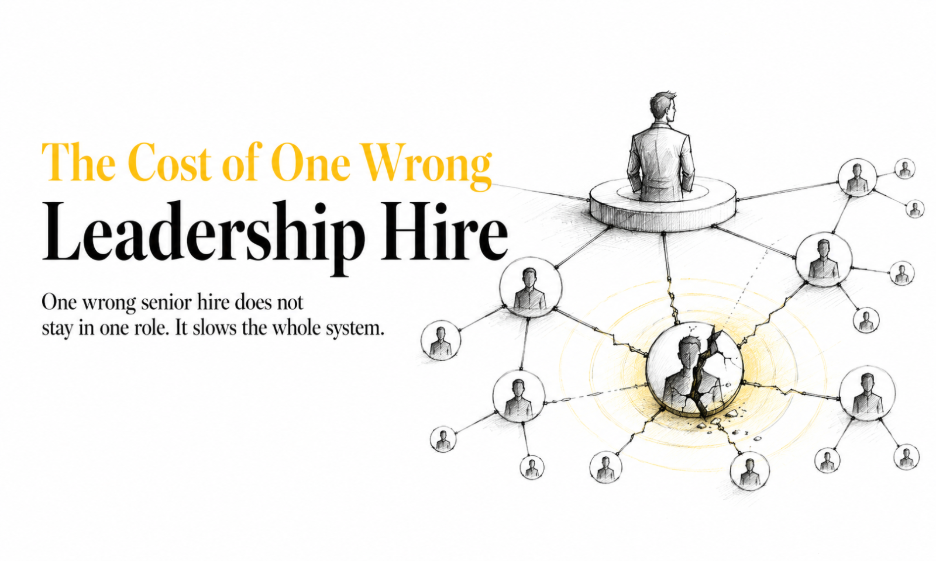
When One Wrong Hire Slows the Whole Company Down
A company is growing well. Revenue has moved from ₹25 crore to ₹60 crore. The market is responding, the team is expanding, customers are coming in, and the company is finally entering the stage where growth feels real. Naturally, the founder decides to build a stronger leadership team so that the business can move beyond founder-led execution.
A senior sales leader is hired. On paper, the person looks perfect: a strong resume, impressive previous company names, confident interview presence, good industry language, and big promises about growth. For the first few weeks, everything seems fine.
Then the problems begin to show. Sales reviews become vague. The pipeline looks active but not reliable. The team is busy, but outcomes are not moving. Targets are missed, but explanations sound polished. Good team members begin to lose energy. Slowly, the founder starts getting pulled back into daily follow-ups.
Six months later, the company is almost back to where it started. Only now, it has lost time, money, momentum, and confidence. The cost was not just the senior leader’s salary. The real cost was delayed growth, weak execution, team confusion, missed revenue, and founder bandwidth.
Most scaling companies would call this a bad hire. In reality, it is usually a weak hiring system.
The Real Problem: Hiring by Impression
Most companies do not intentionally hire the wrong people. They hire based on the signals available to them: resume strength, past company brands, interview confidence, industry experience, founder instinct, and reference checks that rarely reveal enough.
The issue is that these signals are incomplete. A resume tells you what the candidate wants to highlight. An interview tells you how well they can present themselves. A past company name tells you where they worked, not what they truly owned. A reference check often confirms employment, not performance depth. A gut feeling may tell you whether you like the person, not whether they can deliver.
This becomes dangerous when a company starts scaling. At an early stage, founders can still compensate for people gaps. They can jump into sales calls, fix client escalations, rewrite strategy, push execution, and motivate teams directly. But at scale, this is no longer sustainable.
At ₹10 crore, a weak leader may create inconvenience. At ₹100 crore, a weak leader can slow down an entire function. A wrong leadership hire does not stay limited to one role. It affects team morale, revenue predictability, decision-making speed, internal accountability, customer experience, and founder dependency.
This is why scaling companies cannot afford casual hiring decisions, especially for senior roles. They need a system that helps them identify whether someone is truly the right person for the role, the culture, and the stage of growth.

What Could Have Been Done Differently?
The senior sales leader in the example may have cleared a normal interview process easily. But a stronger hiring process would have gone deeper before making the offer.
It would have asked what success in this role actually looks like. It would have clarified what the person must deliver in the first 6, 12, and 18 months. It would have checked whether the candidate had delivered similar outcomes before, whether they were directly responsible for those results, and what patterns showed up across their career.
It would also have looked at why the person left each previous role, what their former managers would say about them, whether they built strong teams or depended only on personal performance, and whether their past bosses would hire them again.
These questions move hiring away from charm and toward evidence. They do not simply ask, “Do we like this person?” They ask, “Has this person repeatedly delivered the kind of outcomes this role needs?”
This disciplined approach to hiring has a name. It is called Topgrading.
What Is Topgrading?
Topgrading is a structured hiring and talent assessment methodology used to identify, hire, develop, and retain A-Players. An A-Player is not simply someone who is talented. It is not someone who speaks well in interviews or has worked at a well-known company.
In the Topgrading context, an A-Player is someone who is among the top available talent for a specific role, at a specific salary level, in a specific business context. That last part is important.
A person may be an A-Player in one company and not in another. Someone who performed well in a large corporate setup may struggle in a founder-led scaling company. A great individual contributor may not become a great manager. A strong operator in a stable business may not succeed in a high-growth, high-ambiguity environment.
Topgrading helps companies define excellence before they evaluate people. That alone changes the quality of hiring decisions.
The Core Elements of Topgrading
1. Scorecard Before Search
Most hiring processes begin with a job description. Topgrading begins with a scorecard.
A job description lists responsibilities, while a scorecard defines outcomes. For example, instead of saying, “Manage the sales team and drive revenue growth,” a scorecard would define success more clearly.
For a sales leadership role, the scorecard may include outcomes such as:
- Improve qualified pipeline by 30% in six months
- Increase conversion from 12% to 18%
- Build a second line of sales managers
- Reduce founder dependency in enterprise closures
- Improve monthly forecasting accuracy
This changes the quality of the hiring conversation. The company is no longer hiring for a title. It is hiring for measurable business outcomes.
2. Chronological Career Interview
Normal interviews often jump from one topic to another. Topgrading uses a chronological career interview where the interviewer walks through the candidate’s career step by step, role by role.
The purpose is to understand the full pattern of performance. What was the person hired to do? What did they actually achieve? How did they work with managers and teams? What mistakes did they make? Why did they move from one role to another? What would their previous bosses say about them?
A single success story can be polished. A career pattern is much harder to fake.
3. Evidence Over Impression
Topgrading reduces dependence on interview performance and increases focus on proof. Instead of accepting broad claims like “I scaled the business,” it asks for specifics.
What was the target? What was the baseline? What changed after the candidate joined? What was directly owned by them? Who else was involved? What would their manager confirm? What did they learn from the misses?
This is especially important in leadership hiring, where confident communication can easily be mistaken for competence.
4. Stronger Reference Checks
Most reference checks are weak. They are usually done late in the process, with handpicked references, and with very safe questions. Topgrading treats reference checks as a serious validation step.
The goal is not to catch the candidate. The goal is to understand the real performance pattern behind the interview. A strong reference check validates strengths, weaknesses, working style, accountability, team impact, reason for exit, and whether the previous manager would rehire the person.
This gives the hiring team a more complete picture before making a high-stakes decision.
5. A-Player Benchmarking
Topgrading does not simply ask whether the person is the best candidate in the current pipeline. It asks whether the person is truly an A-Player for the role.
That is a very different standard.
Many scaling companies hire under pressure. The role is vacant, the team is overloaded, the founder is tired, and the business cannot wait. So the company chooses the best available candidate. But the best available candidate is not always the right candidate.
Topgrading protects the company from this compromise. It forces the leadership team to ask whether the person is good enough to raise the standard of the role, or whether they are being hired because the company is in a hurry.
Why Scaling Companies Need Topgrading More Than Early-Stage Companies?
Every company needs good people, but scaling companies need high talent density. As the business grows, complexity increases quickly. There are more customers, more teams, more processes, more locations, more expectations, and more decisions. At this stage, the company cannot rely only on founder energy.
Leadership quality becomes a growth constraint. One weak function head can slow down a department. One poor manager can trigger attrition. One wrong sales leader can damage revenue predictability. One weak operations head can quietly increase costs. One mis-hire at leadership level can bring the founder back into daily execution.
This is why Topgrading becomes relevant for scaling companies. They do not just need more people. They need better people in critical roles.
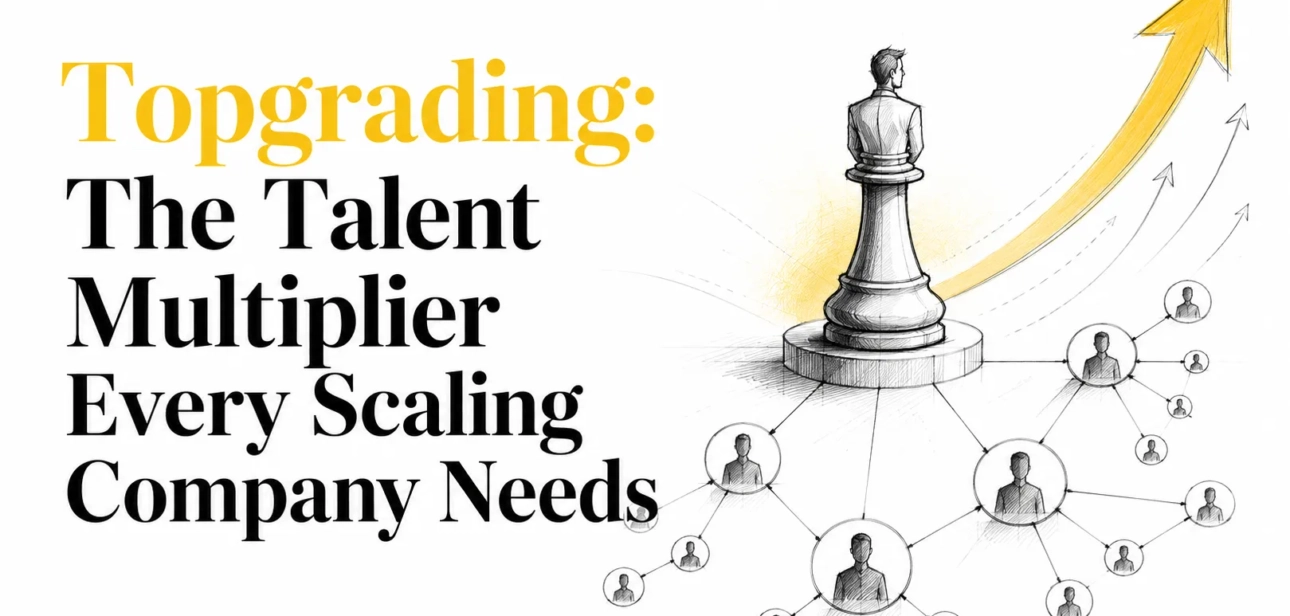
How Topgrading Becomes a Talent Multiplier?
A multiplier is something that increases the output of everything around it. Topgrading works as a talent multiplier because it improves the quality of people decisions. In a scaling company, people decisions directly affect execution, culture, revenue, and founder bandwidth.
1. It Improves Hiring Accuracy
The difference between an average leader and an A-Player is not small. An average sales leader manages targets, while an A-Player builds a revenue engine. An average HR leader fills open positions, while an A-Player improves talent density. An average operations leader keeps things running, while an A-Player builds systems that scale. An average finance leader reports numbers, while an A-Player improves decision-making.
Topgrading helps companies move beyond a good interview and evaluate whether the person has repeatedly delivered real outcomes. That improves hiring accuracy where it matters most.
2. It Reduces the Cost of Mis-hires
The cost of a wrong hire is rarely visible as one clean number. Let us take a simple example.
Suppose a scaling company hires a senior leader at ₹40 lakh annual CTC. If that person exits or underperforms after six months, the visible cost may include:
- Six months of salary: ₹20 lakh
- Recruitment or search cost: ₹4–8 lakh
- Onboarding time and leadership involvement: ₹5–10 lakh
- Replacement hiring cost: ₹4–8 lakh
Even before counting business damage, the direct and semi-direct cost can touch ₹33–46 lakh.
But that is still not the full cost. The hidden cost includes delayed decisions, weak team productivity, missed revenue opportunities, attrition of good employees, customer dissatisfaction, founder time spent correcting execution, and six months of lost momentum.
For a senior role, the real business impact can easily cross ₹1 crore. In some cases, it can be much higher. This is why leadership mis-hiring is not just an HR problem. It is a business risk.
3. It Raises the Standard of the Existing Team
A-Players do not only perform well individually. They raise the standard of the people around them.
When a strong leader enters the system, the operating rhythm changes. Reviews become sharper, metrics become clearer, excuses become harder to hide, good performers feel more energised, average performance becomes more visible, and the team understands what better looks like.
This is the cultural multiplier effect of great hiring. A company does not need A-Players just to improve the org chart. It needs them because they change how the organisation performs.
4. It Protects Founder Time
Founder time is one of the most expensive resources in a scaling company. Every hour the founder spends correcting a weak leader is an hour not spent on strategy, capital, partnerships, expansion, product direction, or culture.
The wrong leader creates reverse delegation. Instead of the founder delegating ownership to the leader, the leader keeps pushing unresolved problems back to the founder. This is how founder dependency survives even after a company has hired senior people.
Topgrading helps reduce this risk by identifying leaders who can genuinely own outcomes. The goal is not to hire people who need constant supervision. The goal is to hire leaders who multiply the founder’s capacity.
5. It Builds a Repeatable Leadership System
Many founder-led companies hire through personal judgement. That may work for some time, but as the company grows, hiring cannot depend only on instinct, chemistry, or urgency.
Topgrading turns hiring into a repeatable system. It creates clear role scorecards, structured interviews, evidence-based evaluation, stronger reference discipline, a common language for talent quality, and better promotion and succession decisions.
This helps the company make better people decisions again and again. That is what makes it scalable.
The Numbers Make the Case Clearer
Let us look at the economics.
Assume a ₹100 crore company has a sales function responsible for ₹40 crore in annual revenue. The company hires the right sales leader through a disciplined Topgrading-led process. This leader improves sales qualification, review discipline, conversion focus, team accountability, forecasting accuracy, and manager capability.
Now assume the sales function improves output by just 10%.
On ₹40 crore revenue, that is a ₹4 crore impact. Even after accounting for salary, incentives, tools, and team investments, the upside is significant.
Now compare this with the wrong hire. A weak sales leader may not only fail to add ₹4 crore. They may also delay decisions, confuse the team, lose good salespeople, damage pipeline quality, and force the founder back into sales reviews.
So the real comparison is not between salary saved and salary spent. The real comparison is between value multiplied and value destroyed.
A wrong hire multiplies cost. An average hire maintains activity. An A-Player multiplies output. Topgrading increases the probability that the company chooses the third.
Why Traditional Hiring Breaks at Scale?
Traditional hiring often fails because it is designed to fill roles, not build capability. It usually over-indexes on interview confidence, past company names, years of experience, urgency to close the role, founder comfort, and surface-level references.
But scaling companies need more than experience. They need people who can operate in ambiguity, build systems, lead teams, own numbers, and reduce founder dependency.
This is why the hiring question has to change. Instead of asking whether the candidate is impressive, the company must ask whether this person can deliver the outcomes the role needs at the current stage of growth.
Topgrading brings that discipline into the process.
What Topgrading Changes Inside the Organisation?
The biggest benefit of Topgrading is not just better external hiring. It changes the company’s entire talent conversation.
It helps leadership teams ask sharper questions:
- Who are our real A-Players?
- Which roles are too important for compromise?
- Where are we tolerating average performance?
- Which managers are multiplying their teams?
- Which managers are silently reducing energy?
- Are we hiring for outcomes or just experience?
- Are we promoting people based on evidence or comfort?
- Do we have enough leadership depth for the next stage of growth?
These are not always easy questions, but scaling companies cannot avoid them. If the business is serious about growth, it has to become serious about talent quality.
How Scaling Companies Can Start With Topgrading
A company does not need to transform its entire hiring process overnight. It can begin with a few practical steps.
Step 1: Create Scorecards for Critical Roles
Start with leadership and business-critical positions. Define success in terms of outcomes, not just responsibilities.
A good scorecard should include business outcomes, functional goals, leadership expectations, behavioural competencies, and success metrics for 6, 12, and 18 months. This gives the hiring team a clear benchmark before interviews begin.
Step 2: Study Existing A-Players
Look inside the organisation. Who consistently delivers without drama? Who raises the standard of others? Who takes ownership? Who learns fast? Who is trusted by peers and managers? Who would be difficult to replace?
Understanding existing A-Players helps the company define what excellence looks like in its own context.
Step 3: Make Interviews More Structured
Do not rely only on casual conversations. Use chronological interviews. Ask for numbers. Ask for examples. Ask about failures. Ask about managers. Ask about team outcomes.
The purpose is not to make the interview uncomfortable. The purpose is to make it real.
Step 4: Strengthen Reference Checks
Reference checks should not be a formality. They should validate patterns.
Ask previous managers about strengths, weaknesses, working style, team impact, accountability, reason for exit, and whether they would rehire the person. This gives the company a more reliable view before making an expensive decision.
Step 5: Review Talent Density Regularly
Talent quality should be reviewed like any other business metric. Companies review revenue, margins, pipeline, costs, and cash flow. They should also review leadership strength, role clarity, succession depth, performance distribution, A-Player concentration, and founder dependency across functions.
At scale, talent is not separate from business performance. It is one of the systems that determines whether growth becomes sustainable or chaotic.
Conclusion: Talent Is the Real Scaling Infrastructure
Most companies think of scaling in terms of strategy, capital, systems, market opportunity, or technology. All of these matter, but none of them work in isolation. Every growth plan eventually has to pass through people. A strong strategy can still fail if the team executing it is average. A good market opportunity can be missed if leaders are slow, unclear, or unable to build accountability. A founder’s vision can become a bottleneck if the organisation does not have enough people who can take real ownership.
This is where Topgrading becomes important for scaling companies. It gives leadership teams a more disciplined way to make people decisions. Instead of hiring based on confidence, chemistry, or urgency, it pushes the company to define what success looks like, study past performance deeply, validate patterns, and identify whether a person can truly deliver the outcomes required for the role.
For a growing company, talent is not just an HR concern. It directly affects revenue, execution speed, culture, customer experience, and founder bandwidth. A wrong hire can quietly slow the company down for months, while the right A-Player can raise the standard of an entire function. That is why Topgrading is not just a hiring methodology. It is a way to build the leadership depth a company needs before growth exposes the gaps.
At some point, every scaling company has to stop asking whether it can afford to be this disciplined about hiring. The larger risk is moving fast with the wrong people in critical roles. Topgrading helps reduce that risk and turns talent into what it should be: a multiplier for growth.