

Share This Article
Most service businesses start the same way: the founder is the product, clients hire you because you’re good, and you deliver the work yourself. Revenue grows, but so does your workload.
Then a ceiling appears. You can’t clone yourself, and you can’t raise prices forever. Growth now depends on your calendar. That’s the moment owners start asking how to build a scalable business model.
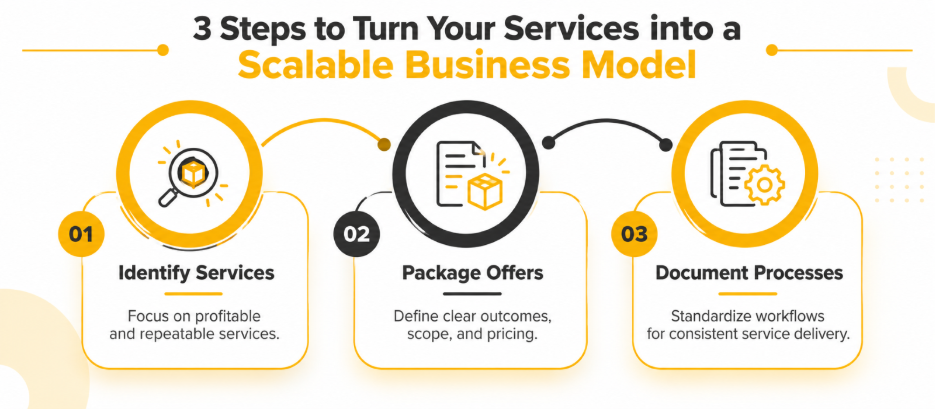
In this guide, we’ll show you how to make that shift in practice.
What “Scalable” Actually Means for a Service Business?
A scalable business model lets revenue grow much faster than the effort and cost required to deliver it. Doubling clients should not mean doubling your hours or your headcount.
Most service firms fail this test. Their model is linear: more revenue needs more people, and more people need more management. Margins stay flat while complexity climbs.
That is why scaling service business operations is harder than scaling a product company. Your product is people’s time, but time has a hard limit.
Step 1: Find What Clients Actually Buy
Start with an honest audit. Look at your last 20 projects. Which ones went smoothly? Which ones drained your team?
Patterns will show up fast. Maybe 70 percent of your best results came from one type of client, solving one type of problem. The rest were custom work that nobody could repeat.
Therefore, your scalable business model lives inside that repeatable 70 percent. Everything else is a distraction, however well it pays.
Step 2: Package the Service
This is the core of any productization strategy. Instead of selling hours or open-ended projects, you sell a defined outcome with a fixed scope, timeline, and price.
Compare two offers:
- “We’ll help with your marketing” (vague, hard to price, hard to repeat)
- “A 6-week brand positioning sprint with three deliverables” (clear,
priceable, repeatable)
The second is easier to sell. It’s also easier to train others to deliver. Clients like it too, because they know what they’re buying.
A good package has four parts: a clear problem, a defined process, fixed deliverables, and a set price. If any one is fuzzy, the package will leak margin.
Step 3: Document How the Work Gets Done
Here’s where most owners stall: they’ve packaged the offer, but the delivery still lives in their head.
Write the process down, not a 50-page manual. Start with a simple sequence: what happens in week one, what the client provides, what your team produces, and what “done” looks like. Record yourself delivering the work once, then turn that into a checklist.
This step feels slow, but it pays back quickly, because every future hire learns from the document instead of from you.

Step 4: Separate Delivery from Ownership
A business can’t scale while the founder is the best and only delivery person. So the next move is to hand off delivery in stages.
Start with the work that follows clear rules. Move the founder toward selling, quality review, and strategy. Keep the judgment-heavy calls for last. Trying to hand off everything at once usually creates quality problems, and then owners pull the work back.
Watch for this trap. It’s common, and it’s covered well in Signs Your Company Is Not Ready to Scale, which explains how scaling magnifies weaknesses already present in the business.
Step 5: Build Leverage Through Systems and Tools
Once the process is documented, look for places where tools can remove manual effort. Intake forms, proposal templates, onboarding sequences, reporting dashboards, and standard client updates are good starting points.
The goal is not to automate everything. It’s to remove the repeated, low-judgment tasks that eat your team’s time. Each hour saved there is an hour available for higher-value work, which is how business growth strategies compound over time.
Step 6: Watch Profit, Not Just Revenue
Many owners celebrate revenue milestones while margins quietly shrink. Adding people and clients can grow the top line while the bottom line stays stuck.
Track gross margin per offer. Track how many hours each package really takes. If a package needs twice the planned effort, fix the scope or raise the price.
This is the difference between growth and healthy growth. If you want to go deeper, Revenue Growth vs Profit Growth: What CEOs Should Focus On lays out why chasing revenue alone can create unstable business models.

Step 7: Expect the Plateau and Plan for It
Even with good systems, growth tends to stall at certain sizes. Complexity rises faster than profit, decisions slow down, and leaders get pulled into daily problems.
This isn’t failure; it’s a predictable stage, and it can be managed. The Basecamp Workshop helps leadership teams step back, identify the constraints holding their business back, and align on the priorities needed for sustainable growth.
The Takeaway
A scalable business model isn’t built by working harder or hiring faster; it’s built by turning what you do into something clear, repeatable, and teachable. Package the service, document the process, hand off delivery, and protect your margins.
Start small, and let each repeatable offer carry more of the load than you do.
FAQs
1. What is a scalable business model?
It’s a model where revenue can grow significantly faster than the cost and effort required to deliver the work. Adding clients doesn’t require adding hours or headcount at the same rate.
2. Can a service business really be scalable?
Yes, but it takes deliberate design. Packaging, documented processes, and delegated delivery let service firms grow without the founder doing everything.
3. What is a productization strategy?
It means turning a custom service into a defined offer with fixed scope, deliverables, timeline, and price, so it can be sold and delivered repeatedly.
4. How is a productized service different from consulting by the hour?
Hourly work sells time. A productized service sells a defined outcome, which makes pricing clearer and delivery easier to repeat.
5. What is the biggest mistake when scaling a service business?
Hiring more people before fixing the process. More headcount on top of unclear delivery usually adds cost and inconsistency, not growth.