

Share This Article
Today, many leadership teams mistake rising revenue, aggressive hiring, or market demand for true business scaling readiness. But scale does not simply magnify success. It magnifies operational weaknesses, leadership blind spots, cultural instability, and execution gaps already sitting beneath the surface.
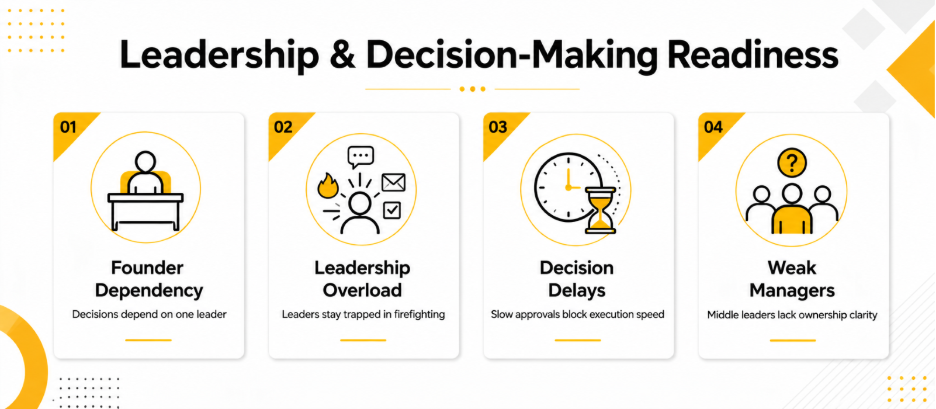
This is where many companies hit a painful turning point. Revenue climbs, but profitability shrinks. Teams expand, but accountability weakens. Decision-making slows down. Customers begin noticing an inconsistency. Leadership spends more time firefighting than leading.
The uncomfortable reality is this: scaling too early can damage a company faster than stagnation.
For CEOs and senior leadership teams, the real question is not “How fast can we grow?” It is “Can our organization absorb growth without breaking operationally, financially, and culturally?”
Below are the clearest signs your company is not truly prepared for scale and why ignoring them creates long-term consequences.
1. The Founder Remains the Operating System
One of the strongest indicators of poor business growth readiness is excessive founder dependency.
If critical decisions, customer escalations, hiring approvals, strategy alignment, and execution momentum still revolve around one person, the company has not built scalable leadership infrastructure.
In many growing organizations, founders unintentionally become operational bottlenecks because the business has evolved around their speed, instincts, and relationships. That works in earlier stages. However, it becomes dangerous during expansion.
Signs This Is Happening
- Project progression depends on the founder’s approval
- Leaders avoid making independent decisions
- Cross-functional alignment only happens when the founder intervenes
- Customers expect direct founder involvement
- Strategy exists primarily inside the founder’s head
Scaling requires institutional capability, not heroic leadership.
Companies with strong business scaling readiness build systems where execution continues smoothly even when founders step away temporarily.
2. Revenue Is Growing Faster Than Operational Discipline
Strong revenue growth often breeds complacency within an organization.
Some companies assume scaling is working because sales numbers look strong. Meanwhile, margins deteriorate, delivery timelines slip, employee burnout rises, and operational complexity multiplies.
Growth without operational maturity often creates expensive chaos disguised as momentum.
Common Symptoms
Processes Exist Informally
Teams rely on tribal knowledge instead of documented systems.
Delivery Quality Becomes Inconsistent
Customer experience varies depending on which team handles the account.
Leadership Meetings Become Reactive
Most discussions focus on solving urgent issues rather than improving long-term capability.
Hiring Outpaces Integration
New employees enter unclear structures with inconsistent onboarding and weak accountability.
This is why experienced operators treat operational stability as a prerequisite for scale, not a side project after growth arrives.

3. Leadership Bandwidth Is Already Maxed Out
A company approaching scale requires leaders who can think strategically while managing increasing complexity.
If your executive team already spends most of its time in escalation loops, internal conflict resolution, and daily operational firefighting, additional growth will likely overwhelm the organization.
One of the clearest indicators of weak business scaling readiness is leadership exhaustion.
Watch for These Patterns
- Executives consistently work in reactive mode
- Strategic priorities change every quarter
- Leaders attend too many operational meetings
- Senior teams struggle to delegate effectively
- Decision fatigue slows momentum
Scaling multiplies communication demands, execution coordination, and operational interdependencies. Leadership teams without capacity can quickly become friction points inside the business.
4. Teams Are Growing, But Alignment Is Shrinking
As organizations expand, communication complexity increases.
What once worked through informal conversations no longer works across larger teams, multiple departments, and layered management structures.
This is where misalignment quietly starts damaging performance.
Signs of Organizational Misalignment
Departments Operate With Different Priorities
Sales optimizes for growth while operations focuses on damage control.
Teams Interpret Strategy Differently
Leadership communicates vision, but execution varies wildly across departments.
Accountability Becomes Unclear
Projects stall because ownership is fragmented.
Meetings Increase While Clarity Decreases
More collaboration does not automatically create better alignment.
Therefore, companies with strong business growth readiness establish execution rhythms, measurable priorities, and leadership accountability.
Without that structure, expansion creates confusion faster than progress.
5. Your Middle Management Layer Is Weak
Many companies underestimate how important middle management becomes during scaling.
Founders and executives cannot directly manage every operational detail once organizations grow beyond a certain point. That’s why middle managers become the translators between strategy and execution.
When this layer is weak, scale collapses under communication gaps and inconsistent execution.
What Weak Middle Management Looks Like
- Managers act as task coordinators instead of leaders
- Escalations constantly move upward
- Teams depend heavily on senior leadership for direction
- Performance conversations rarely happen
- Managers struggle with accountability enforcement
Strong middle management creates operational stability during growth. Weak middle management creates organizational dependency on executives.
That dependency becomes unsustainable at scale.
6. Decision-Making Is Slowing Down
Fast-growing companies often experience invisible decision paralysis.
As complexity increases, approval layers multiply. Stakeholders expand. Risk tolerance decreases. Teams hesitate because accountability structures remain unclear.
This slows execution dramatically.
Signs of Decision Friction
Projects Stay in Discussion Loops
Meetings produce conversations instead of movement.
Teams Avoid Ownership
Employees escalate decisions upward to avoid risk exposure.
Strategic Priorities Keep Shifting
Lack of clarity creates constant course correction.
Cross-Functional Coordination Breaks Down
Departments optimize locally rather than organizationally.
Companies prepared for scale build decision-making frameworks early. They define ownership, escalation paths, and operational authority before complexity overwhelms execution speed.
7. Culture Is Starting to Fracture
Culture problems rarely appear during stable growth periods. They become visible under pressure.
Rapid hiring, organizational restructuring, leadership inconsistency, and execution stress often expose cultural weaknesses that previously remained hidden.
One of the most overlooked elements of any scaling business checklist is cultural resilience.
Warning Signs of Cultural Strain
- High-performing employees begin disengaging
- Internal politics increase
- Teams lose trust in leadership communication
- Burnout becomes normalized
- Accountability standards vary across departments
Culture is not built through slogans or internal presentations. It is shaped through leadership behavior, operational consistency, hiring discipline, and execution expectations.
8. Customer Experience Is Becoming Inconsistent
Customer deterioration is often one of the earliest external signs that a company lacks true business scaling readiness.
As operational complexity increases, businesses sometimes prioritize acquisition over delivery consistency. Customers begin experiencing delays, communication breakdowns, inconsistent service quality, or unresolved issues.
Growth numbers may still look strong temporarily, but retention risk quietly increases underneath.
What Leaders Often Miss
Customer Complaints Become Operational Signals
Recurring issues often reflect deeper structural weaknesses.
Teams Start Managing Exceptions Constantly
Operational systems no longer support increasing demand smoothly.
Customer Success Turns Reactive
Teams spend more time recovering relationships than strengthening them.
Scalable organizations design customer experience systems capable of maintaining consistency even during aggressive expansion phases.
9. Financial Complexity Is Increasing Faster Than Financial Visibility
Many growing companies generate more revenue while simultaneously losing financial clarity. This creates dangerous scaling conditions.
Without financial clarity, companies often scale inefficient operations while believing growth equals progress.
Financial Red Flags
- Revenue grows while cash flow tightens
- Margins fluctuate unpredictably
- Hiring decisions outpace financial planning
- Operational costs rise without visibility
- Forecasting accuracy declines
Sustainable scaling requires disciplined financial management, not just top-line growth.
This is one reason experienced scaling firms place equal focus on People, Strategy, Execution, and Cash rather than treating revenue as the primary scorecard.
10. Your Company Runs on Effort Instead of Systems
Many organizations survive growth through sheer employee effort.
People work longer hours. Leaders compensate manually for broken workflows. Teams rely on urgency instead of structure.
That approach works temporarily. It eventually collapses.
The Real Question Leaders Must Ask
If growth doubled within 12 months, would your systems absorb the pressure, or would your people absorb the pain?
Companies ready for scale build systems capable of supporting expansion predictably. Absence of these systems leaves business growth highly vulnerable.
Final Thoughts
True business growth readiness means your leadership structure, financial visibility, operational systems, cultural alignment, and execution discipline can handle complexity without constant instability.
If your organization recognizes several of the signs above, now is the right time to strengthen the foundations before pressure intensifies further.
Leadership teams looking to assess their operational maturity and scaling capability can explore the Success Alchemists Basecamp Workshop, which focuses on building predictable growth systems across People, Strategy, Execution, and Cash. Get in touch with us!
FAQs
1. Why do some companies struggle after rapid growth?
Many companies grow revenue faster than their operational capability. This creates leadership overload, execution gaps, inconsistent customer experiences, hiring challenges, and financial inefficiencies that become harder to manage as complexity increases.
2. How can founders tell if they are becoming a bottleneck?
Founders often become bottlenecks when major decisions, escalations, approvals, and strategic direction depend heavily on them. If teams slow down without founder involvement, the company may lack scalable leadership structures.
3. What are the biggest operational signs a business is not ready to scale?
Common warning signs include inconsistent processes, poor cross-functional alignment, reactive leadership meetings, rising employee burnout, delayed decision-making, and growing customer complaints during expansion.
4. Why is middle management important during scaling?
Middle management aligns leadership strategy with daily execution. Strong managers create accountability, maintain operational consistency, and support team performance as organizations grow larger and more complex.
5. Can revenue growth hide scaling problems?
Yes. Revenue growth can temporarily mask operational inefficiencies, weak profitability, poor systems, and leadership strain. Companies sometimes appear successful externally while internal execution deteriorates rapidly.