


Share This Article
For decades, businesses have celebrated revenue growth as the ultimate indicator of success. Headlines glorify billion-dollar valuations, rapid market expansion, and aggressive scaling. Yet behind many high-growth companies lies a less glamorous reality: shrinking margins, operational inefficiencies, cash flow pressure, and unstable business models.
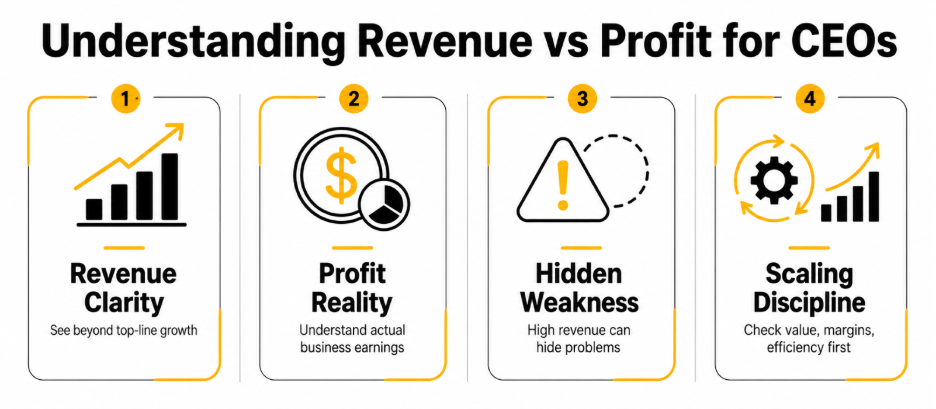
This is where the debate around revenue vs profit becomes critical.
A company can double its revenue and still become financially weaker. On the other hand, a business with disciplined profitability often gains greater resilience, investor confidence, and long-term enterprise value. The challenge for leadership teams is not choosing one over the other blindly. The real challenge is understanding which growth lever deserves priority at a specific stage of the business lifecycle.
For CEOs and executive leaders, growth today is no longer about “getting bigger at any cost.” It is about building organizations that scale intelligently, compete strategically, and generate sustainable value.
Understanding Revenue Growth vs Profit Growth
Revenue growth measures how quickly a company increases sales over time. It reflects market demand, customer acquisition success, expansion efforts, and sales performance. Meanwhile, profit growth measures how efficiently a company converts revenue into actual earnings after operational costs, taxes, salaries, and investments.
The distinction matters because revenue can mask underlying financial reality.
A SaaS company may achieve 70% annual revenue growth while burning through capital at unsustainable rates. Meanwhile, a manufacturing firm growing at 15% annually with strong margins and healthy cash reserves may actually hold stronger long-term positioning.
The revenue vs profit discussion becomes even more important in volatile economic environments where investor expectations shift from growth-at-all-costs toward operational efficiency and capital discipline.
Therefore, CEOs must ask deeper questions:
- Is revenue growth creating enterprise value?
- Are margins improving alongside expansion?
- Does scale improve efficiency or magnify inefficiencies?
- Is the company building durable profitability?
These questions separate sustainable businesses from fragile ones.
Why High Revenue Does Not Always Mean Business Success?
One of the most dangerous assumptions in business leadership is equating high revenue with strength.
History offers countless examples of fast-growing companies collapsing under weak profitability structures. Businesses often expand aggressively through discounting, excessive hiring, or expensive customer acquisition strategies without building a financially healthy foundation.
Therefore, revenue growth can sometimes hide structural problems like:
- Weak pricing models
- High customer churn
- Low operational efficiency
- Poor cost visibility
- Dependency on external funding
- Unprofitable customer segments
CEOs frequently fall into the trap of chasing vanity metrics because revenue growth creates external validation. Investors, media, and competitors often reward visible expansion. However, markets eventually shift focus toward profitability, particularly during economic slowdowns.
This transition has become increasingly visible across global technology and startup ecosystems. Companies once rewarded purely for scale are now being evaluated on EBITDA performance, cash flow management, and operational sustainability.
For executive leaders, this signals an important reality: growth without financial discipline eventually creates strategic vulnerability.

When CEOs Should Prioritize Revenue Expansion?
Despite the risks, there are specific business scenarios where prioritizing revenue growth makes strategic sense.
Companies operating in emerging markets or highly competitive industries often need rapid expansion to establish market dominance. In sectors driven by network effects, first-mover advantage can outweigh short-term profitability concerns.
Examples include:
- SaaS platforms
- Marketplaces
- AI-driven products
- Consumer technology ecosystems
- Subscription-based businesses
In these environments, scale can strengthen customer retention, improve data advantages, and create barriers for competitors.
However, effective revenue growth strategies require precision rather than reckless expansion.
Therefore, CEOs should prioritize revenue growth when:
- Customer lifetime value exceeds acquisition costs
- The market opportunity is time-sensitive
- Economies of scale improve future margins
- Expansion creates defensible market positioning
- The company has strong capital access and operational clarity
Strategic revenue growth focuses on high-value customers, profitable channels, and scalable systems rather than simply increasing top-line numbers.
When Profitability Should Become the Main Focus?
At certain stages, profitability becomes more important than quick expansion.
This shift often happens when:
- Market growth slows
- Capital becomes expensive
- Competition intensifies
- Operational complexity increases
- Economic uncertainty rises
In these periods, leadership priorities must evolve.
A business generating strong profits gains strategic flexibility. It can reinvest internally, weather downturns, attract investors more confidently, and make long-term decisions without depending heavily on external funding.
Profitability also reflects operational maturity. Companies with healthy margins typically demonstrate:
- Strong pricing power
- Efficient workflows
- Smart resource allocation
- Effective leadership alignment
- Better customer retention
- Greater financial resilience
This is why many experienced CEOs eventually transition from aggressive scaling to disciplined optimization.
The Hidden Risks of Scaling Without Profit Discipline
Scaling without financial discipline creates hidden operational damage that many leadership teams notice too late.
Rapid growth can increase:
- Organizational inefficiency
- Employee misalignment
- Customer service inconsistency
- Supply chain pressure
- Decision-making complexity
- Cash flow instability
A company may appear successful externally while internally struggling with fragile operations.
This is why the revenue vs profit conversation must remain central at the executive level.
How Strategic Leadership Balances Revenue and Profit Together?
The most effective CEOs do not treat revenue and profit as opposing forces. They understand that sustainable growth requires both.
Revenue fuels expansion. Profit fuels resilience.
Therefore, strategic leadership involves balancing:
- Short-term opportunities with long-term stability
- Market expansion with operational control
- Customer acquisition with retention quality
- Innovation with financial discipline
This balance requires constant recalibration. The strongest leaders recognize that sustainable scale comes from clarity, discipline, and strategic alignment across the organization.
How the Basecamp Workshop Helps CEOs Build Sustainable Growth?
The Basecamp Workshop helps CEOs and business leaders gain clarity on growth priorities, operational scalability, leadership alignment, and long-term profitability.
Rather than offering generic business frameworks, the workshop focuses on practical leadership transformation and strategic thinking designed for modern business environments.
For CEOs navigating revenue vs profit, our program provides a structured environment to evaluate business models, leadership decisions, and scalable growth opportunities with greater precision.
Final Thoughts
The debate around revenue vs profit is not about choosing growth or profitability in isolation. It is about understanding which lever creates stronger long-term enterprise value at the right moment.
Revenue without profit can create instability. Profit without growth can limit competitive relevance. Therefore, modern leadership demands more than chasing bigger numbers. It demands building businesses that grow stronger as they grow larger.
If your leadership team is re-evaluating growth priorities, operational scalability, or long-term profitability, our workshop could be the next step toward building a more high-performing organization. Get in touch with us!
FAQs
1. Why is the revenue vs profit debate important for CEOs?
The revenue vs profit discussion helps CEOs decide whether the business should focus on rapid expansion or operational profitability based on market conditions, business maturity, and long-term strategic goals.
2. Can a company grow revenue while losing money?
Yes. Many companies increase revenue through aggressive marketing, discounting, or expansion strategies while still operating at a loss due to high expenses and low margins.
3. When should a business prioritize revenue growth?
Businesses should prioritize revenue growth when entering new markets, building market share, leveraging network effects, or scaling products with high long-term customer value potential.
4. When should CEOs focus more on profitability?
Profitability should become a priority when market conditions tighten, operational complexity rises, investor expectations shift, or businesses need stronger financial stability and cash flow control.
5. Why does high revenue not always indicate business success?
High revenue does not automatically mean a business is financially healthy. Poor margins, weak pricing strategies, high customer acquisition costs, and inefficient operations can reduce long-term sustainability.