


Share This Article
Crossing ₹50 crore in revenue is a big milestone. Yet for many businesses, this stage also marks the beginning of something far more frustrating: the business growth plateau.
Revenue stabilizes. Expansion slows. Leadership teams work harder but see diminishing returns. Internal complexity rises faster than profitability. What once felt like momentum begins to feel like resistance.
This is the phase where many founders and CEOs start asking the uncomfortable question: Why business growth stops even when demand still exists?
The answer is rarely market demand alone. More often, the plateau emerges because the systems, leadership structure, and operational discipline that helped a company reach ₹50Cr are no longer sufficient to take it to ₹200Cr and beyond.
Scaling a business beyond this point requires a fundamentally different way of operating.
The Hidden Shift That Happens After ₹50Cr
In the early stages of growth, companies often succeed because of founder energy, speed, and aggressive execution. Decisions happen quickly. Teams stay aligned through proximity. Problems are solved informally.
But as revenue grows, operational complexity compounds.
Suddenly, the founder becomes the bottleneck for approvals.
Departments optimize for their own goals instead of company-wide outcomes. Middle management expands, but accountability weakens. Meetings increase while execution slows.
The organization that once thrived on agility begins to suffer from internal friction.
This is one of the most overlooked growth challenges in companies operating at scale. What worked at ₹10Cr can actively damage performance at ₹100Cr.
Leadership Bottlenecks Become Expensive
At ₹50Cr+, founder dependency becomes dangerous.
Many businesses at this stage still rely heavily on the CEO for strategic direction, decision-making, customer escalation, hiring approvals, and cross-functional coordination. While this approach may have accelerated early growth, it creates severe limitations during scaling.
As a result, leaders become trapped in operational firefighting instead of strategic thinking. Teams wait instead of taking ownership. Innovation slows because employees hesitate to act without founder validation.
This is where mature businesses often experience a business growth plateau despite having strong products and market demand.
Execution Misalignment Quietly Kills Growth
In many ₹50Cr+ companies, different departments operate with different priorities.
Individually, these goals may make sense. Collectively, they create organizational drag.
Without alignment, teams work hard but pull in different directions.
This misalignment becomes especially costly during expansion into new markets, product lines, or geographies. The leadership team may believe the company has a clear strategy, but employees across the organization interpret priorities differently.
The result is slower execution, internal confusion, and wasted resources.
This is precisely why frameworks like Scaling Up emphasize structured accountability, communication rhythms, measurable priorities, and organizational clarity, because scaling complexity cannot be managed through intuition alone.
Complexity Increases Faster Than Revenue
Growth introduces operational layers that many businesses underestimate.
Without scalable systems, complexity expands faster than revenue.
This often leads to the illusion of growth without corresponding profitability.
Revenue may rise marginally, but margins shrink. Teams grow larger, yet productivity falls. Meetings multiply while strategic clarity declines.
These are classic symptoms of a business growth plateau.
The issue is not growth itself. The issue is unmanaged scaling complexity.
Companies that break through this stage invest heavily in operational infrastructure, process standardization, leadership capability, and data-driven decision-making.
They stop relying on heroic effort and start building repeatable systems.
The Four Scaling Pillars Most Companies Neglect
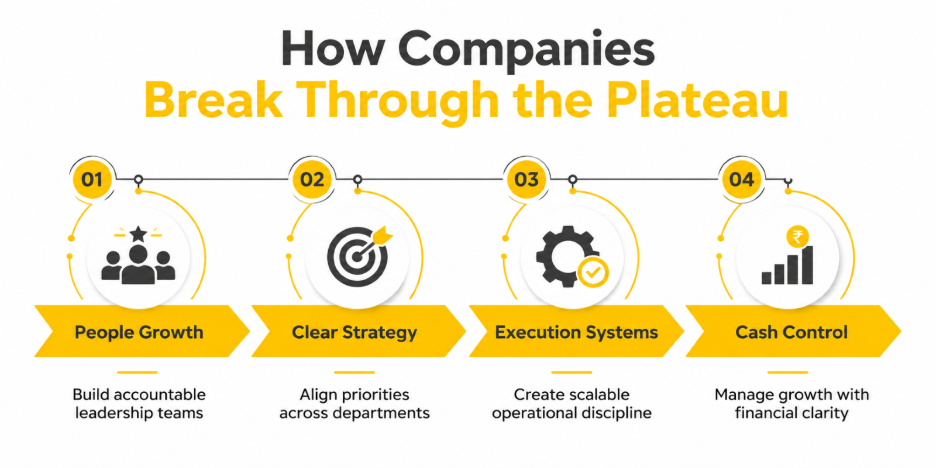
One reason some businesses continue scaling while others stagnate is their ability to balance four critical pillars simultaneously: People, Strategy, Execution, and Cash.
People
Many growth-stage companies outgrow their leadership team before they realize it.
The skills required to build a ₹10Cr business are not the same skills needed to scale a ₹200Cr organization. Leadership gaps become more visible as complexity rises.
Companies that scale effectively invest in leadership development, accountability structures, succession planning, and cultural alignment.
They build teams capable of making decisions independently rather than escalating every issue upward.
Strategy
A surprising number of companies lose focus after initial success.
As opportunities increase, businesses start chasing too many directions simultaneously — new markets, new verticals, new services, new partnerships.
However, strategic dilution weakens execution.
Strong scaling organizations simplify their priorities. They define clear market positioning, measurable long-term goals, and operational focus areas that align the entire company.
Execution
Execution discipline separates scalable companies from overwhelmed ones.
This includes structured meeting rhythms, transparent KPIs, quarterly priorities, cross-functional accountability, and operational visibility.
When execution systems are weak, even brilliant strategies fail.
Companies stuck in a business growth plateau often do not lack intelligence. They lack operational consistency.
Cash
Growth consumes cash faster than many CEOs anticipate. Expanding teams, increasing inventory, delayed receivables, technology investments, and market expansion can create severe cash-flow pressure even in profitable businesses.
Poor cash discipline is one of the most underestimated growth challenges in companies scaling aggressively.
However, sustainable growth requires financial visibility, forecasting discipline, and strategic allocation of resources, not just revenue growth.
Why Scaling Feels Harder Than Starting?
Many founders assume the hardest phase of business is surviving the early years.
In reality, scaling can be far more difficult.
Startups operate with simplicity. Scaling organizations operate with interdependence.
At ₹50Cr+, small inefficiencies compound rapidly. Weak communication affects hundreds of employees. Poor hiring decisions impact entire departments. Strategic confusion creates company-wide execution gaps.
This is why businesses that reach substantial revenue often feel unexpectedly stuck. Breaking through requires organizational redesign, not just increased effort.
The Plateau Is Not the Problem, Staying There Is
A business growth plateau is not necessarily a sign of failure.
In many cases, the company reaches a level where informal leadership and instinct-driven execution are no longer enough. However, companies that break through growth ceilings are usually the ones willing to rethink how they operate, lead, execute, and scale. They stop treating growth as a sales problem alone and start viewing it as an organizational capability challenge.
That shift changes everything.
Scale Beyond the Plateau with Success Alchemists
For CEOs and leadership teams navigating scaling complexity, operational misalignment, and stalled growth, structured guidance can dramatically shorten the learning curve.
At Success Alchemists, we work with growth-stage businesses to help leaders scale with greater clarity, execution discipline, and organizational alignment using globally recognized scaling methodologies.
Our 1-day Basecamp Workshop helps CEOs, founders, and leadership teams build scalable systems across People, Strategy, Execution, and Cash using globally trusted scaling frameworks.
Gain practical insights, align your leadership team, and create a clear roadmap for sustainable growth beyond the plateau. Get in touch with us!
FAQs
1. What is a business growth plateau?
A business growth plateau is a stage where a company’s revenue, profitability, or expansion slows down despite continued effort and market presence. It commonly happens when operational complexity outpaces leadership systems and execution capability.
2. Why business growth stop after reaching ₹50Cr?
Many companies experience slower growth after ₹50Cr because the founder-led systems that worked earlier become ineffective at scale. Leadership bottlenecks, execution gaps, and organizational misalignment are common reasons why business growth stops.
3. What are the biggest growth challenges in companies scaling beyond ₹50Cr?
The most common growth challenges in companies include leadership dependency, poor cross-functional alignment, cash-flow pressure, hiring gaps, decision fatigue, and lack of scalable systems.
4. How can CEOs identify a business growth plateau early?
Signs include stagnant revenue despite higher effort, increasing operational chaos, slower decision-making, declining margins, poor accountability, and teams working in silos.
5. Why do growing companies struggle with execution?
As businesses expand, communication layers increase and priorities become unclear. Without structured execution systems, teams lose alignment, resulting in slower delivery and inconsistent performance.