

Share This Article
In boardrooms, discussions around profitability often revolve around operational efficiency, expansion plans, customer acquisition, or digital transformation. Yet one of the most powerful drivers of profit growth frequently receives less strategic attention than it deserves: pricing strategy.
A well-designed pricing strategy does far more than determine what customers pay. It shapes market perception, influences buying behavior, protects margins, strengthens competitive positioning, and directly affects enterprise value.
Research from McKinsey & Company has consistently shown that a 1% improvement in pricing can generate a significantly larger increase in operating profit than a comparable increase in sales volume or reduction in fixed costs. That reality explains why market-leading organizations invest heavily in pricing intelligence, analytics, and pricing strategy consulting to optimize profitability.
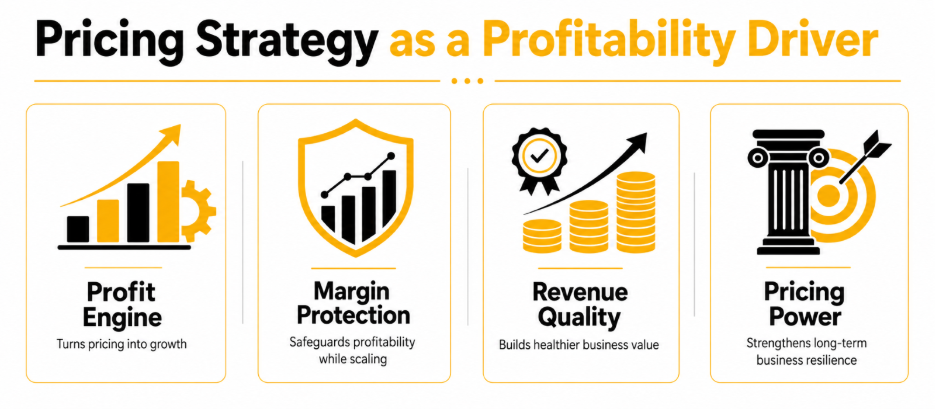
Pricing Strategy Is a Profit Engine, Not a Sales Tool
Many organizations still approach pricing reactively. Competitor pricing changes trigger adjustments. Sales pressure drives discounts. Procurement negotiations reduce margins quarter after quarter. Over time, this creates a culture where price becomes defensive rather than strategic.
High-performing companies operate differently.
They view pricing strategy as a long-term profitability framework tied directly to brand positioning, customer value perception, and financial goals. Instead of asking, “What price will help us close more deals?” they ask, “What pricing structure maximizes lifetime profitability while strengthening market position?”
That distinction changes everything.
A discount-driven company often competes in shrinking-margin environments. A value-driven company competes on differentiated outcomes, customer experience, innovation, or measurable business impact.
Consider enterprise software markets. Two SaaS providers may offer similar technical functionality, but one commands significantly higher pricing because customers associate it with reliability, integration capability, lower operational risk, and executive-level support. The higher price itself reinforces premium market positioning.
Pricing influences perception as much as perception influences pricing.
The Direct Relationship Between Pricing Strategy and Margins
Revenue growth without margin protection creates fragile businesses. Many companies scale aggressively only to discover that profitability remains stagnant because pricing models fail to capture value effectively.
This is where pricing for profit becomes critical. Strategic pricing decisions influence:
- Gross margins
- Contribution margins
- Customer acquisition economics
- Retention profitability
- Cash flow stability
- Long-term valuation multiples
Therefore, executives should regularly evaluate whether pricing reflects:
- Product differentiation
- Market maturity
- Customer dependency
- Switching costs
- Industry demand elasticity
- Competitive alternatives
In volatile economic conditions, pricing discipline becomes even more important. Rising operational costs cannot always be absorbed internally.
However, companies with strong pricing power maintain profitability because customers perceive their offerings as strategically valuable rather than interchangeable commodities.
This is one reason investors closely examine pricing power when evaluating market-leading companies.

Why CEOs Should Treat Pricing as a Strategic Leadership Function
Pricing decisions affect every major business function.
Sales teams rely on pricing structures to position value. Finance teams depend on pricing for forecasting and profitability management. Marketing teams use pricing to communicate brand positioning. Product teams build packaging strategies around pricing architecture.
Despite this interconnected impact, pricing ownership often remains fragmented. However, executive leadership involvement changes outcomes substantially.
When CEOs actively participate in pricing strategy discussions, organizations tend to:
- Maintain stronger pricing discipline
- Reduce unnecessary discounting
- Improve customer segmentation
- Align pricing with long-term positioning
- Increase enterprise profitability
Pricing leadership also creates internal clarity. Teams start understanding which customers generate strategic value and which business segments dilute margins.
Competitive Positioning Starts With Strategic Pricing
Price communicates market position instantly.
Luxury brands use premium pricing to reinforce exclusivity. Technology leaders use tiered pricing to expand market penetration while protecting high-margin enterprise offerings. Retail giants deploy dynamic pricing to maximize volume and inventory movement.
Every pricing structure sends a signal.
A common executive mistake is assuming that lower pricing automatically drives market competitiveness. In reality, aggressive price reductions often weaken brand perception and trigger margin-destroying price wars.
Strategic pricing creates differentiation without necessarily lowering prices.
For example:
- Value-based pricing highlights measurable customer outcomes.
- Usage-based pricing aligns cost with customer growth.
- Tiered pricing expands accessibility while preserving premium positioning.
- Bundled pricing increases perceived value and account expansion.
Companies with mature pricing strategy frameworks rarely compete solely on price. They compete on economic value delivered.
This is particularly important in B2B sectors where buying decisions involve operational risk, implementation complexity, and long-term vendor relationships.
Data-Driven Pricing Is Reshaping Executive Decision-Making
Modern pricing strategy relies heavily on analytics. Executives now have access to real-time data on:
- Customer purchasing patterns
- Price sensitivity
- Churn behavior
- Competitive shifts
- Regional demand fluctuations
- Product profitability
This data empowers organizations to move beyond static pricing models toward adaptive pricing strategies.
Airlines, hospitality companies, SaaS providers, and e-commerce platforms have used dynamic pricing for years. Increasingly, traditional industries are adopting similar approaches.
However, data alone does not create profitability. The real advantage comes from interpreting pricing signals correctly.
For example, rising sales volume after a price reduction may initially appear positive. But if contribution margins decline substantially or premium customers shift toward lower-priced packages, long-term profitability may suffer.
That’s why executives need pricing visibility beyond topline revenue. This explains the growing demand for pricing strategy consulting among enterprise organizations. External pricing experts often help businesses identify hidden revenue leakage, optimize packaging structures, and redesign pricing architectures aligned with profitability goals.
Customer Psychology Plays a Bigger Role Than Many Executives Realize
Pricing is not purely mathematical. It is psychological.
Customers rarely evaluate price in isolation. They evaluate perceived value relative to alternatives, business outcomes, reputation, and risk reduction.
This creates powerful strategic opportunities.
A company positioned as the “cheapest option” often struggles to maintain customer loyalty because buyers can easily switch when another low-cost competitor enters the market.
By contrast, organizations positioned around expertise, reliability, innovation, or premium service build stronger pricing resilience.
Behavioral economics also influences buying decisions through:
- Anchoring effects
- Decoy pricing
- Tier comparison
- Scarcity perception
- Subscription framing
Executives who understand pricing psychology can create pricing structures that improve both conversion rates and profitability simultaneously.
Pricing Strategy Will Define the Next Generation of Market Leaders
As markets become increasingly competitive, pricing sophistication will separate industry leaders from margin-constrained competitors.
Artificial intelligence, predictive analytics, and customer intelligence platforms are transforming how businesses approach pricing decisions.
Companies capable of adapting pricing dynamically while maintaining customer trust will gain significant advantages in profitability and market share.
Yet technology alone is not enough. A successful pricing strategy still depends on executive alignment, customer understanding, operational discipline, and clear market positioning.
Organizations that master pricing for profit build stronger financial resilience, improve shareholder confidence, and create sustainable competitive advantages that extend far beyond revenue growth.
At Success Alchemists, our leadership frameworks help founders and senior executives build scalable business systems. For leadership teams looking to strengthen strategic decision-making, the Basecamp Workshop offers practical insights into building profitable and scalable organizations using globally recognized Scaling Up methodologies. To know more, get in touch with us!
FAQs
1. Why is pricing strategy important for profitability?
Pricing strategy directly affects margins, revenue quality, customer perception, and long-term financial performance. Even small pricing improvements can create a significant increase in operating profit.
2. How does pricing strategy influence competitive positioning?
Pricing communicates market value and brand perception. A strategic pricing model helps businesses differentiate themselves without relying solely on discounts or price reductions.
3. What is pricing for profit?
Pricing for profit is a strategic approach focused on maximizing profitability instead of simply increasing sales volume. It aligns pricing with customer value, market demand, and business goals.
4. Why do CEOs need to be involved in pricing decisions?
Pricing affects every major business function, including sales, finance, marketing, and operations. CEO involvement helps align pricing with long-term growth strategy and profitability objectives.
5. What are the risks of poor pricing strategy?
Weak pricing strategy can lead to margin erosion, excessive discounting, customer confusion, reduced brand value, and declining profitability despite revenue growth.