

Share This Article
Growth is exciting until the systems that helped build the business start slowing it down. Many mid-sized companies reach a stage where revenue is rising, teams are expanding, and market demand looks promising, yet operations start to feel heavier instead of faster. Decisions take longer. Leaders spend more time fixing internal confusion than driving strategy. Cash flow tightens despite higher sales. Accountability becomes blurred across departments.
These are not signs of failure. They are classic scaling challenges that appear when a business outgrows its original structure.
In this blog, we’ll discuss the most common business growth challenges mid-sized companies face and the practical strategies leadership teams can use to solve them before growth turns chaotic.
Why Scaling Becomes Difficult for Mid-Sized Companies?
In early growth stages, speed often comes from founder-driven decision-making, small teams, and informal communication. But once a company grows beyond a certain point, those same habits begin creating friction.
What worked at ₹20 crore in revenue rarely works at ₹200 crore.
Mid-sized companies often sit in a difficult middle ground:
- Too large to operate informally
- Too small to absorb major inefficiencies
- Growing fast enough for complexity to multiply monthly
This is where many scaling problems in companies start surfacing.
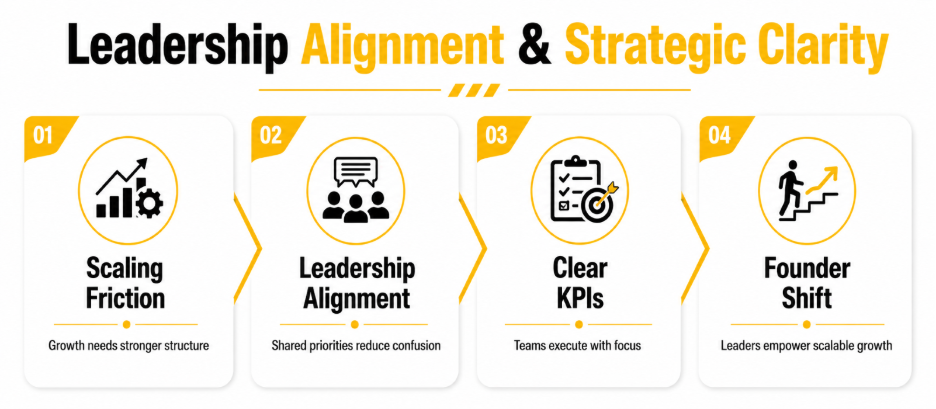
Leadership Misalignment Slows Strategic Growth
One of the most underestimated scaling challenges is leadership inconsistency. In many mid-sized companies, department heads operate with different priorities:
- Sales pushes aggressive acquisition targets
- Operations focuses on cost control
- HR prioritizes hiring speed
- Finance tries to preserve cash
- Product teams chase innovation
Individually, these goals make sense. Collectively, they can create organizational drift.
The Hidden Cost of Leadership Misalignment
When executives are not aligned around a shared growth strategy:
- Teams receive conflicting directions
- Decision-making slows down
- Accountability weakens
- Execution becomes reactive instead of intentional
A CEO may believe the company is scaling strategically, while employees experience constant firefighting internally. This disconnect creates operational fatigue across the organization.
How to Solve It?
Leadership alignment requires structured communication rhythms and shared visibility into company priorities. Many successful scaling organizations adopt frameworks centered around:
- Clear quarterly priorities
- Shared KPIs
- Cross-functional accountability
- Weekly executive alignment meetings
- Defined ownership across strategic goals
The strongest leadership teams operate from one playbook, not individual departmental agendas.

Operational Complexity Increases Faster Than Revenue
Growth naturally creates complexity. More customers, more employees, more systems, and more processes all increase operational load. However, many companies add complexity without redesigning workflows.
The result?
- Duplicate work
- Communication bottlenecks
- Delayed approvals
- Process confusion
- Team dependency on a few key individuals
This becomes one of the most expensive business growth challenges because inefficiency compounds silently over time.
The “Hero Employee” Problem
Many mid-sized businesses rely heavily on a few experienced employees who “know how everything works.” While this may seem efficient initially, it creates risk:
- Knowledge stays undocumented
- Teams become dependent on tribal information
- Scaling stalls when key employees leave or burn out
Operational maturity requires systems, not heroics.
How to Solve It?
Companies scaling successfully typically focus on process visibility before automation. Key actions include:
- Mapping critical workflows
- Standardizing recurring processes
- Defining decision authority
- Documenting operational knowledge
- Reducing unnecessary approvals
Technology helps, but clarity matters more than software. Without operational discipline, companies often automate confusion instead of solving it.
Cash Flow Problems Often Appear During Growth
One of the most misunderstood scaling challenges is the relationship between growth and cash flow. Higher revenue does not automatically mean healthier finances.
In fact, fast-growing companies frequently experience:
- Delayed receivables
- Rising hiring costs
- Inventory strain
- Increased customer acquisition expenses
- Expanding overhead
Growth consumes cash before it generates stable returns.
Why Mid-Sized Companies Get Caught Off Guard?
Executives often focus heavily on top-line growth while underestimating operational cash demands.
For example:
- A company lands multiple enterprise clients
- Delivery teams expand rapidly
- Payroll increases immediately
- Client payments arrive 60-90 days later
Revenue grows on paper while cash pressure intensifies behind the scenes.
How to Solve It?
Leadership teams must treat cash as a strategic scaling metric, not just a finance function. Therefore, strong scaling organizations regularly review:
- Cash conversion cycles
- Gross margin trends
- Hiring efficiency
- Client profitability
- Forecast accuracy
Predictable scaling requires financial visibility across departments, not isolated reporting inside finance teams.
Company Culture Breaks Down During Expansion
Culture problems rarely appear overnight. They emerge gradually as organizations grow faster than their communication structures.
Many mid-sized companies experience:
- Reduced accountability
- Department silos
- Employee disengagement
- Internal politics
- Loss of clarity around company direction
Founders often say:
“The company doesn’t feel the same anymore.”
That feeling usually signals structural strain, not simply cultural decline.
Scaling Culture Requires Intentional Design
In smaller companies, culture spreads naturally through proximity. In larger organizations, culture must be operationalized.
That means:
- Defining core behaviors clearly
- Building accountability systems
- Reinforcing leadership consistency
- Creating transparent communication channels
Culture is not built through motivational messaging alone. It is shaped through everyday operational behavior.
How to Solve It?
Companies that scale effectively create organizational clarity around:
- Roles
- Expectations
- Performance standards
- Communication rhythms
- Decision-making processes
Employees perform better when they understand how their work connects to larger company goals. This alignment becomes critical as businesses scale across locations, teams, and management layers.
Execution Breaks When Priorities Multiply
As companies grow, opportunities multiply rapidly:
- New markets
- New partnerships
- New products
- New customer segments
- New hires
The challenge isn’t opportunity, it’s focus. Many scaling problems in companies stem from trying to pursue too many priorities simultaneously.
Complexity Creates Strategic Drift
Without execution discipline:
- Teams lose clarity
- Projects stall
- Meetings increase
- Urgency replaces strategy
- Leaders spend more time reacting than building
Due to this, organizations become busy but ineffective. This is one of the clearest signs that scaling requires a stronger operating framework.
How to Solve It?
Strong execution comes from narrowing focus. Therefore, leadership teams should:
- Identify a small number of strategic priorities
- Define measurable outcomes
- Assign clear ownership
- Review progress consistently
- Remove low-value initiatives
Execution improves dramatically when teams know what matters most.
Many executive teams also benefit from external facilitation and strategic workshops designed to improve alignment and operational focus. Programs like the Basecamp Workshop help leadership teams identify scaling bottlenecks, align around growth priorities, and create actionable execution plans.
Founders Must Shift From Operators to Scale Leaders
One of the hardest transitions during scaling happens at the leadership level.
Founders who built the company through direct involvement often struggle to step back operationally.
Common patterns include:
- Micromanagement
- Slow decision approval
- Limited delegation
- Leadership bottlenecks
- Overdependence on the founder
This creates organizational drag as the business grows.
Scaling Requires Leadership Evolution
The skills required to build a business are not always the same skills required to scale it.
At scale, leaders must move from:
- Doing → directing
- Solving → enabling
- Controlling → empowering
- Reacting → forecasting
The company cannot grow sustainably if every major decision flows through one person.
How to Solve It?
Executives must build leadership infrastructure around:
- Delegation frameworks
- Decision ownership
- Leadership development
- Performance accountability
- Strategic planning rhythms
Companies that scale well distribute leadership capacity instead of centralizing it.
Scaling Requires More Than Growth Ambition
Most mid-sized companies do not fail because of poor products or a lack of market demand. They struggle because complexity grows faster than operational maturity. The organizations that scale successfully build systems around:
- People
- Strategy
- Execution
- Cash
They replace reactive management with structured operating rhythms. They create accountability across leadership teams. They treat scaling as a discipline, not a phase.
For executive teams serious about long-term growth, Basecamp Workshop by Success Alchemists can become a powerful starting point toward building a more aligned and scalable business. Get in touch with us!
FAQs
1. What are the biggest scaling challenges for mid-sized companies?
The biggest scaling challenges typically include leadership misalignment, operational inefficiencies, cash flow pressure, execution breakdowns, talent management issues, and lack of scalable systems.
2. Why do scaling problems in companies happen even when revenue is growing?
Revenue growth often increases operational complexity. Without structured systems, aligned leadership, and financial visibility, companies can experience internal chaos despite higher sales.
3. How can CEOs identify early signs of scaling issues?
Common warning signs include delayed decision-making, recurring operational bottlenecks, employee burnout, communication gaps, inconsistent execution, and declining profitability during growth.
4. Why is leadership alignment important during scaling?
Leadership alignment creates clarity across departments, improves execution speed, strengthens accountability, and helps organizations move toward common strategic goals.
5. What role does cash flow play in business scaling?
Cash flow directly impacts hiring, operations, expansion, and long-term sustainability. Fast-growing businesses often struggle financially if growth outpaces cash management.