

Share This Article
Strategies rarely fail on paper. They die on Tuesday morning. You want everyone to move forward, but the rigid org charts, incentive plans, and a leadership team that’s still being measured on last year’s priorities.
McKinsey has consistently found that roughly 70 percent of large-scale transformation efforts fail to achieve their objectives. The firm attributes many of these failures to factors like not setting an aspiration high enough to matter, a workforce that never genuinely buys in, and inadequate investment in the capabilities needed to sustain change.
None of those three causes is a strategy problem. All three are CEO problems.
In this blog, we’ll discuss what CEOs who actually pull off business transformation do differently and why many of them rely on business transformation consulting to bridge the gap.
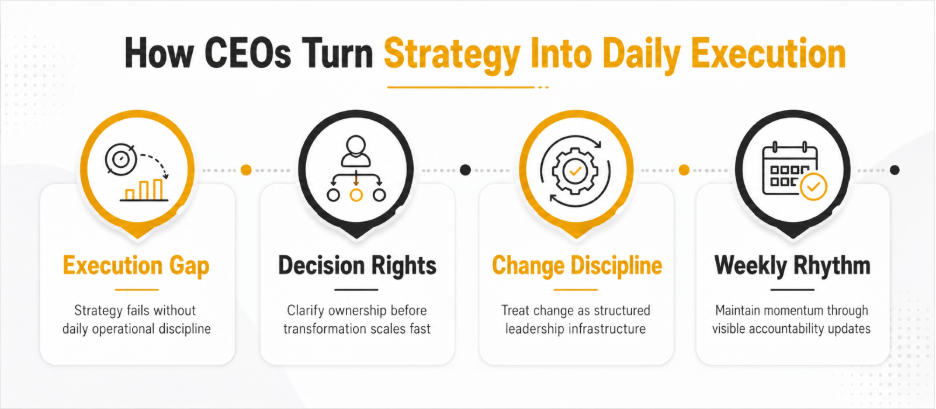
Why Business Transformation Is a CEO Problem, Not a Project
Let’s clear one thing first: improvement projects and full-scale business transformations are two completely different things.
A process improvement project changes one thing — a workflow, a system, a function — while everything else holds steady. A genuine business transformation changes strategy, structure, capability, and culture at the same time, because each one constrains the others. You can’t redesign the decision-making process without touching who holds power. You can’t shift the growth model without retraining the people executing it. You can’t change behavior without changing what gets rewarded.
That interdependence is exactly why transformation can’t be handed off entirely to an external advisory firm. A CFO can own a cost program. A COO can own an operating model redesign. But only the CEO sits at the intersection of all four dimensions — strategy, structure, capability, and culture — with the authority to make trade-offs across them.

The Real Reason Most Transformations Stall
Ask most leadership teams whether they have a strategy problem, and they’ll say no. They have a plan. What they actually have, more often, is an execution gap. They fail because companies struggle to convert a plan into coordinated daily action once the organization gets large.
Therefore, a CEO leading transformation has to close that gap directly. It’s not by writing a better strategy document, but by redesigning how the organization makes decisions, allocates time, and holds itself accountable week to week. That’s where business transformation consulting becomes the key. It builds the momentum needed to turn big decisions into everyday habits. It helps build the operating rhythm that turns decisions into repeatable action.
1. They Own the “Why” — Personally, Not Through a Memo
Employees don’t commit to a transformation because a slide says it’s necessary. They commit because they trust. Ideally, the CEO who cares about team stability, their customers, and their own growth.
who lead successful transformation say the same core message dozens of times, in person, in their own words, until it stops sounding like an announcement and starts sounding like conviction. The CEOs who delegate this to a town-hall slide or an internal newsletter routinely watch engagement evaporate within a quarter.
2. They Fix Decision Rights Before They Scale the Effort
Growth has a way of quietly turning the CEO into the bottleneck. As the company gets bigger, more decisions still route through the same single mind, and momentum dies waiting in the inbox for an answer. It’s a pattern that shows up constantly during transformation, when the volume of decisions spikes as the organization needs speed the most. CEOs who lead transformation well redesign who can decide what, before launch, not six months in when frustration has already set in.
4. They Treat Change Management as a Discipline, Not an Afterthought
Change management is frequently treated as a communications exercise bolted onto the end of a project plan. However, CEOs who lead successful transformation treat it as core infrastructure. A defined rhythm of communication, named executive sponsors who are visible and active (not just listed on an org chart), and a deliberate plan for engaging with employees who will resist change by default. Skipping this discipline is one of the most common reasons transformation budgets get spent without the results to show for it.
5. They Know Exactly What to Outsource
This is where business transformation consulting fits into the picture. The CEOs who get the most out of consultants use them for things an internal team just can’t do alone. You need that outside perspective that doesn’t care about office politics. You need frameworks that have actually been tested at hundreds of other companies, and a strict routine that stops your big project from quietly dying. But the one thing you can’t outsource is leadership. A consultant can draw the map, but only the CEO can get the team to actually follow it.
A Practical Starting Framework for the First 90 Days
If you’re a CEO heading into a transformation, here’s a sequence that holds up better than launching with an all-company kickoff event:
- Weeks 1–2: Get honest about the trigger. Most transformations start because growth has stalled or margins are compressing, not because someone decided change would be interesting.When your growth plateaus, it’s actually a great diagnostic tool. It forces you to look under the hood and pinpoint the real bottleneck before you spend money trying to fix the wrong thing.
- Weeks 3-4: Audit your leadership bench, not just your strategy. Identify which seats have the judgment to lead through ambiguity and which don’t, before the transformation exposes the gap publicly.
- Weeks 5-6: Redesign decision rights. Decide, explicitly and in writing, which decisions you will personally retain and which you are pushing down, and tell the organization both.
- Weeks 7-10: Build the communication cadence. Set a recurring rhythm (weekly is common) for updates, wins, and setbacks. Silence is what kills belief in a transformation faster than bad news does.
- Weeks 11-13: Define leading indicators, not just lagging ones. Revenue and margin will move last. Track adoption, decision speed, and engagement weekly so you can correct course before the financial numbers tell you it’s too late.
A structured self-assessment can shortcut the first phase considerably.
The Bottom Line
Business transformation succeeds or fails based on what the CEO does personally, not on what gets written in the strategy document. The organizations that beat the odds are led by CEOs who own the narrative themselves, fix decision-making before scaling the effort, and bring in business transformation consulting for things an internal team can’t supply.
FAQs
1. What is business transformation consulting, and how is it different from regular management consulting?
Business transformation consulting focuses specifically on enterprise-wide change across strategy, operations, structure, and culture simultaneously, usually tied to a defined outcome like a growth inflection or a turnaround.
2. How long does a typical business transformation take to show results?
Early operational and behavioral changes are usually visible within 90 to 180 days. However, many transformations need 12 to 18 months before the bulk of the intended value shows up in the numbers.
3. What’s the real difference between “business transformation” and “organizational transformation”?
Business transformation usually refers to strategy, business model, and market position. Organizational transformation is the subset focused specifically on structure, roles, decision rights, and talent.
4. How does change management fit into business transformation consulting?
Change management is the discipline that keeps people engaged with the transformation while it’s happening — communication, sponsorship, resistance planning, and reinforcement of new behaviors. Skipping it usually makes the transformation slower.
5. Should a CEO build an internal change team or bring in external business transformation consulting partners?
Most CEOs benefit from a hybrid: external business transformation consulting partners for objective diagnosis, proven frameworks, and an outside accountability structure, paired with an internal team that owns day-to-day execution and retains the institutional knowledge once the engagement ends.