

Share This Article
You can fill your pipeline, close record-breaking deals, and still watch your business suffer. It happens more often than the headlines admit.
But the truth is, growth does not fix cash flow problems. In most cases, it amplifies them. The faster you scale, the more cash your operations consume. As a result, it widens the gap between when money leaves your hands and when it comes back. That gap is where businesses die.
In this blog, we break down where those cash flow traps hide and what you can do before they cost you the business.
Why Growing Businesses Are Actually More Vulnerable?
There is a counterintuitive reality every executive must internalize. The growth phase is when a business is most financially fragile, not least. A business doing ₹5 crore a year operates in a different financial environment from one targeting ₹50 crore. The receivables cycle stretches. Inventory commitments grow. Headcount scales before revenue catches up. Fixed costs get locked in against projected, not confirmed, demand.
In our Scaling Up coaching practice, this constant tug-of-war between speeding up growth and running out of cash is one of the very first things we tackle.
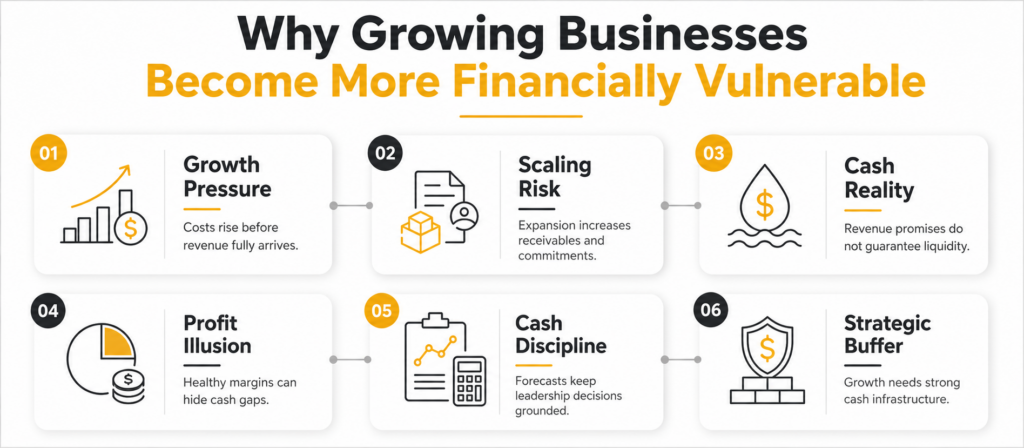
The 6 Cash Flow Traps That CEOs Walk Into
1. Confusing Revenue With Cash
This is the most common and most expensive blind spot. Revenue is a promise. Cash is a fact. When you book a sale on 60-day payment terms, you have created a receivable, not liquidity. Yet many businesses make hiring decisions, investment decisions, and expansion decisions based on revenue projections rather than confirmed cash positions.
To survive, you have to build the habit of staring at a 13-week cash runway every single week. Relying strictly on a yearly P&L sheet won’t cut it when things move this fast. That’s where the real findings live.
2. Extended Receivables Cycles Draining Working Capital
If your sales team is closing deals on 60-to-90-day payment terms to win business, someone needs to run the math on what that costs in working capital. Receivables sitting beyond 45 days are effectively an interest-free loan you are extending to your customers, funded by your own operating capital.
The fix starts upstream: tighter terms at the point of sale, early-payment incentives, and prompt invoicing on day one, not day five after delivery. The Cash Acceleration Strategies (CAS) framework available through Success Alchemists provides a structured method to identify exactly where cash is getting stuck in your cycle and how to release it.
3. Over-Investing in Inventory or Capacity Before Demand Confirms
When you’ve survived the lean years as a founder, it’s easy to panic-buy during a growth spurt. You end up building inventory buffers and infrastructure that the current revenue base cannot support. The instinct is understandable. The financial consequence is not.
Expanding your capacity too early is a trap. It feels like a brilliant growth move at the time, right up until the next quarter hits and you realize the cash just isn’t coming in. Therefore, work to match capital deployment with confirmed, not projected, demand cycles.
4. Profit Illusion: When Margins Look Fine, But Cash Is Tight
This one surprises executives. A business can be EBITDA positive and still face a liquidity crisis. Because gross margin and cash timing are different dimensions of financial health. Depreciation, deferred payments, accruals, and loan repayments can all distort the P&L into looking healthier.
If you are running a business above ₹10 crore in revenue and you are not separating your cash flow statement analysis from your income statement, you are flying partially blind. These are two different instruments.
5. Growth-Driven Overhiring Ahead of Cash Coverage
Scaling headcount is one of the least reversible cash commitments a growing business makes. Salaries are fixed, monthly, and contractually obligated. However, revenue is variable. Aggressive hiring against ‘maybe’ deals is a fast way to break your budget.
Therefore, you need to build a direct link between your cash flow forecast and your hiring plan. Every headcount addition should map to a specific, confirmed revenue stream. This is a principle the Scaling Up framework coaches use.
6. Ignoring the Power of One
Even small adjustments across several financial levers can easily result in a major cash boost. A one-day reduction in your receivables cycle, a one-day extension in your payables, or a one-point improvement in gross margin can release substantial working capital without any new revenue.
This concept, developed and popularized through the Scaling Up methodology, is called the Power of One. It consistently reveals cash that was already sitting in the business simply because nobody was looking at these levers systematically.

What Excellent Businesses Do Differently?
The businesses that navigate cash flow traps well are not necessarily more profitable. They are more deliberate. Here is what separates them:
They treat the cash conversion cycle as a board-level metric. They run a 13-week cash flow forecast as a living operational document. They align sales terms, operations timelines, and financial commitments into a single integrated view. And most importantly, they build cash reserves not as an afterthought but as a strategic buffer. These companies typically target between 2 and 3 months of operating expenses in accessible liquidity.
Cash discipline is a culture, and like all cultures, it starts at the top. If the CEO is not talking about Days Sales Outstanding (DSO), Days Payable Outstanding (DPO), and the cash conversion cycle in leadership meetings, the rest of the organization will not treat it as a priority either.
The Strategic Takeaway for CEOs
Growth is an asset only if the cash infrastructure supports it. Every time you sign a new contract or add capacity, you are making a cash commitment that will arrive before the projected revenue. That lag is where cash flow traps form.
If you want an honest diagnosis of where your cash flow traps are hiding, a structured assessment against the four pillars of People, Strategy, Execution, and Cash is a good starting point. Get in touch with us!
FAQs
1. How can my business be growing fast but still run out of money?
Growth actually devours cash. As you scale, your operational expenses shoot up immediately. Meanwhile, the money from your new sales might not hit your bank account for months.
2. Can a profitable business actually run out of cash?
Yes. Profitability is an accounting measure. Cash availability is a liquidity measure. A business can show profit on its income statement while simultaneously facing a cash crisis due to timing mismatches in receivables, payables, or debt repayment.
3. How much cash reserve should a growing business maintain?
A commonly applied benchmark is 2 to 3 months of operating expenses in accessible liquidity. However, this varies by industry and debt obligations.
4. How do extended payment terms create cash flow traps?
When you sell on 60-to-90-day terms, you are effectively financing your customers’ operations with your own working capital. If your salaries, suppliers, and rent are due in 30 days, you face a structural cash gap that compounds as revenue grows.
5. What is the Power of One framework for cash management?
The Power of One demonstrates that a one-unit improvement across key financial levers — price, volume, COGS, receivables days, payables days, inventory days — generates a disproportionate cash and profit impact. It is a powerful diagnostic tool for identifying cash levers without needing new revenue.