

Share This Article
Most CEOs don’t fail because they lack a good plan. They fail because the plan never turns into a rhythm the company follows. Strategy gets set at a January offsite, then quietly forgotten by March. That gap between what leadership decided and what teams do every week is where growth stalls.
This is the exact problem Verne Harnish set out to solve in 2002, when he wrote Mastering the Rockefeller Habits. He later expanded the ideas into Scaling Up, but the core insight hasn’t changed. Companies that scale well don’t run on inspiration. They run on habits. For any CEO thinking seriously about a scaling business strategy, the Rockefeller Habits are still one of the most practical places to start.
What the Rockefeller Habits Actually Are?
The name comes from a story about John D. Rockefeller holding a consistent daily meeting with his leadership team to review numbers and decisions. Whether every detail of that story is precise or not, the principle behind it stuck. Disciplined routines beat sporadic brilliance.
Harnish organized this thinking into what’s now called the Four Decisions every company has to get right: People, Strategy, Execution, and Cash. You can read a full breakdown of how these four decisions fit together in the Scaling Up framework.
In Harnish’s framework, execution comes down to three core disciplines: Priorities, Data, and Rhythm. Nail those down, and your scaling strategy stops being a slide deck and actually becomes how the team gets things done on an average Tuesday afternoon.
Why Execution Breaks Down as Companies Grow?
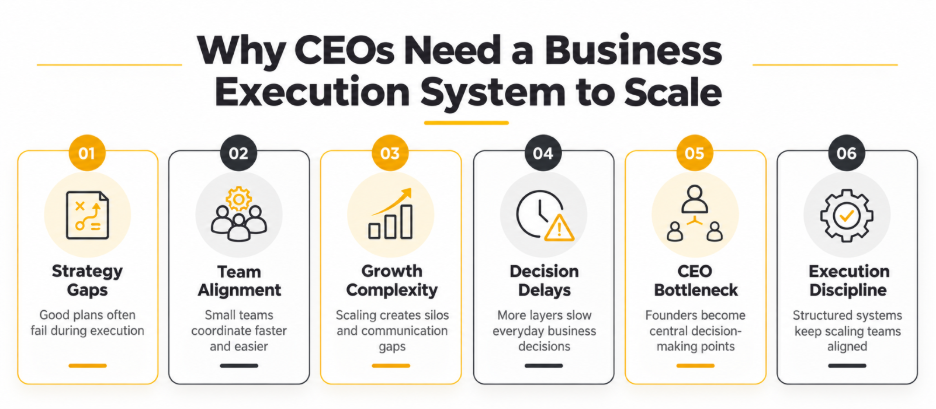
At ten people, alignment happens by accident. Everyone sits near each other, hears the same conversations, and adjusts in real time. However, that informal system quietly falls apart somewhere between 20 and 50 employees.
New hires don’t carry the context founders hold in their heads. Departments start optimizing for their own goals instead of the company’s. And decisions that used to take an hour now take three meetings and a follow-up email chain.
This is exactly where a business execution system becomes necessary. Without one, the CEO becomes the bottleneck for every decision, which is the opposite of what scaling is supposed to achieve. A functioning business execution system pushes decisions down to the people closest to the work, without leadership losing visibility.
The Three Disciplines Behind a CEO Execution Framework
Priorities. A CEO execution framework starts with fewer priorities. Harnish’s model pushes companies toward a small number of quarterly priorities, ideally three to five, tied to one Critical Number the whole company can see and influence. The discipline isn’t picking the priorities; it’s saying no to everything else that quarter.
Data. Lagging indicators, like last quarter’s revenue, tell you what already happened. Leading indicators, like sales calls booked this week, tell you what’s about to happen. Therefore, any real growth plan needs both, but most companies over-invest in the former and ignore the latter. Weekly scorecards that track five to fifteen leading numbers give leadership a way to catch problems while there’s still time to fix them.
Rhythm. This is the piece most companies skip, and it’s the one that makes the other two work. Without a fixed meeting rhythm for scaling companies, priorities drift, and data goes unread.

Building a Meeting Rhythm for Scaling Companies
The Rockefeller Habits meeting rhythm has four layers:
Daily huddle (10-15 minutes). A stand-up focused on what’s blocking people today. Keep it short enough that skipping it feels like the exception, not the norm.
Weekly meeting (60-90 minutes). This is the main engine room. Review the scorecard, flag issues, and properly solve one or two of them instead of skimming past ten.
Monthly or quarterly review (half a day). Step back from weekly noise. Check progress against the quarter’s priorities and adjust before it’s too late.
Annual planning (one to two days). Set the strategy, Critical Number, and priorities for the year ahead, usually captured on a One-Page Strategic Plan.
If you’ve just crossed a big revenue mark, those hidden execution bottlenecks tend to reveal themselves in predictable ways: slower cross-team decisions and a company that still heavily depends on the founder.
Where CEOs Get This Wrong
Three mistakes show up again and again.
First, treating the daily huddle as optional once things get busy. It’s precisely when things get busy that the huddle matters most.
Second, running weekly meetings as status updates instead of problem-solving sessions. If everyone already knew the update from a shared document, the meeting wasted an hour.
Third, changing the quarterly priorities mid-quarter because something urgent came up. But urgent isn’t the same as important. Constantly shifting priorities trains the team to stop taking them seriously.
Starting This Week
A CEO doesn’t need a consultant to begin. Pick one Critical Number for the next 90 days, set three priorities that move it, and start a daily huddle.
Building this alone is possible. But most leaders find the structure holds better with outside accountability. That’s the gap a structured Scaling Up coaching engagement is built to close, walking CEOs through the same Priorities, Data, and Rhythm disciplines, with someone checking whether the rhythm actually held.
Request a callback and start this week.
FAQs
1. What are the Rockefeller Habits, in simple terms?
They’re a set of disciplines for running a growing company on Priorities, Data, and Rhythm instead of guesswork. Verne Harnish first wrote about them in 2002, drawing on the idea that consistent daily and weekly habits build a stronger company than occasional bursts of effort.
2. Who created the Rockefeller Habits framework?
Verne Harnish, founder of the Entrepreneurs’ Organization and author of Scaling Up, developed the framework. The name references a story about John D. Rockefeller’s disciplined daily review meetings with his leadership team.
3. What’s the difference between the Rockefeller Habits and Scaling Up?
Scaling Up, published in 2014, is Harnish’s expanded follow-up to his original 2002 book, Mastering the Rockefeller Habits. Scaling Up added the Four Decisions structure (People, Strategy, Execution, Cash) around the same core habits.
4. What is a CEO execution framework?
It’s a repeatable system for turning strategy into daily and weekly action. In the Rockefeller Habits model, that means a short list of priorities, a scorecard of leading and lagging data, and a fixed meeting rhythm.
5. How long should a daily huddle be?
Ten to fifteen minutes is the standard target. The goal is to surface blockers quickly, not to review every task in detail.