

Share This Article
Every founder remembers the early days fondly. Ten people, one group chat, and everyone knew exactly what everyone else was doing. If something slipped, you noticed by lunchtime. Nobody needed a scorecard to catch it.
Then the company grows. Headcount doubles. Then it doubles again. Suddenly, the same founder who once caught every dropped ball is hearing about problems three weeks late. It happens in a board meeting, off a slide someone else prepared. But nothing dramatic broke, and the team didn’t get lazier. What actually happened is accountability stopped scaling with the business.
This is one of the most predictable failure points in company growth. It’s also one of the least discussed. Most CEOs assume accountability is a personality trait. Some people have it; some don’t. In practice, it’s a system. Like any system, it either grows with the company or quietly collapses under the new weight.
Why Growth Breaks Accountability?
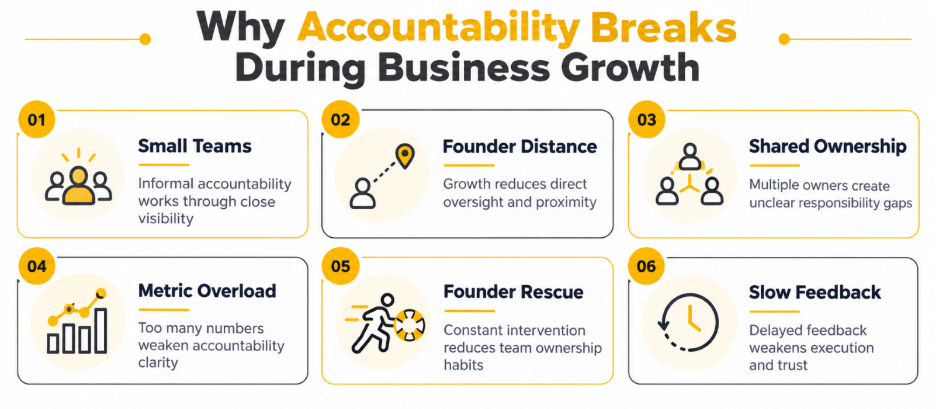
In a small team, accountability is informal by default. Ownership lives in proximity. You see the work. You see the person doing it, and the feedback happens in real time.
However, growth removes that proximity. Layers appear between the CEO and the actual work. A single owner for a task turns into three people who each assume someone else has it. Meetings multiply, but decisions slow down. This is the same pattern we unpacked in how CEOs build a company that can scale without their daily involvement. The founder who was once the fastest path to a decision becomes the slowest, simply because too much funnels through one person.
A few specific things tend to go wrong at this stage:
- Ownership gets shared, so nobody really owns it. When a goal has three names next to it “for visibility,” it effectively has zero owners.
- Metrics multiply faster than clarity does. A dashboard with forty numbers and no clear owner is noise with a nicer interface.
- Founders keep making exceptions. Every time a CEO quietly steps in to “just fix it,” the team learns the deadline was optional. That habit feels helpful short-term and does damage long-term.
- Feedback loops stretch out. In a ten-person team, feedback is same-day. In a two-hundred-person team, without a deliberate structure, it can stretch to a monthly or quarterly review. That’s far too slow to correct course.
The Real Cost of Blurred Ownership
The cost isn’t just missed deadlines. It shows up as slower decisions, duplicated effort, and a leadership team that spends more energy managing confusion than managing the business. Therefore, leadership accountability in growing companies isn’t a soft, feel-good topic. It shows up directly in cash flow, in customer experience, and in how fast a company can actually execute its strategy.
There’s a quieter cost too: trust. When ownership stays vague, your strongest performers start absorbing the slack left by everyone else. Over time, that breeds resentment. As a result, your best people often leave first, not because they can’t handle growth, but because they’re tired of carrying it alone.

Building a CEO Accountability Framework
A working CEO accountability framework rests on a few simple ideas. The discipline is in applying them consistently, not in the ideas themselves.
One name per number. Every goal, metric, or deliverable gets exactly one owner. Not a team. Not a department. A person. If two people are needed on it, one is still the owner, and the other is support.
Written commitments, not verbal nods. “Sounds good” in a meeting isn’t a commitment. A specific deliverable, a specific date, and a specific owner, written down where everyone can see it, is a commitment.
A weekly rhythm, not a quarterly surprise. Short, consistent check-ins catch problems while they’re still small. This is the same logic behind the operating cadence we covered, from annual strategy to weekly execution. Plans fail less from bad thinking and more from irregular follow-up.
Consequences that actually get followed through. Not punitive ones. Clear ones. If a commitment slips, the conversation happens within days, not three months later at a performance review.
How CEOs Improve Team Ownership?
Ownership isn’t installed with a memo. It’s built through repetition. A few moves tend to shift it fast:
- Stop rescuing every dropped ball yourself. Let the owner solve it, with your support, not your takeover.
- Ask “who owns this” out loud in every meeting where a task comes up. It sounds small. It changes behavior within weeks.
- Replace status updates with commitment reviews. Instead of “how’s it going,” try “did you do what you said you’d do?”
- Give people real decision rights, not just tasks. Ownership without authority is just extra stress with a nicer title.
Leadership teams that get this right tend to resemble the structure described in how to build an A-team leadership group. It’s a small group of people who each hold one lane completely.
Where Business Coaching and Mentoring Fits In?
Most CEOs already know all of this, at least in theory. The hard part is applying it consistently while also running the business day-to-day. This is exactly where business coaching and mentoring come in.
Good business coaching and mentoring for CEOs isn’t built around motivational talk. It’s built around installing the weekly rhythms, the scorecards, and the direct conversations most leadership teams need. That structure is the real difference. It separates reading about a CEO accountability framework from actually running one, every week, in every meeting.
If you’re already noticing the signs, take note. You can start with a quick assessment to see exactly where accountability is breaking down in your organization.
FAQs
- What does it actually mean when accountability “breaks” during growth?
It means ownership stops being clear. Tasks and goals still get assigned, but no single person is truly on the hook for them. Things slip, and nobody notices until it’s a bigger problem.
- Why does accountability get harder as a company scales, even with good people?
Because informal accountability depends on proximity. In a small team, everyone sees everyone’s work. As layers and distance grow between the CEO and the front line, that natural visibility disappears, and it has to be replaced with a deliberate structure.
- What is a CEO accountability framework?
It’s a repeatable system for assigning clear ownership and capturing commitments in writing. It also reviews progress on a set rhythm and follows through on consequences when something slips. It replaces guesswork with a process everyone can rely on.
- How is leadership accountability in growing companies different from accountability in a small team?
In a small team, accountability is informal and happens naturally through direct contact. In a growing company, it needs formal owners, written commitments, and scheduled check-ins, or it quietly disappears as headcount and layers increase.
- How can CEOs improve team ownership without micromanaging?
Give people real decision-making authority alongside their responsibilities, then step back and let them solve problems before stepping in. Ownership grows when people are trusted to fix things, not just assigned to watch them.