

Share This Article
For years, growth meant the same thing for most CEOs: work more, decide more, be everywhere. That formula works, until it does not. Somewhere between fifty and five hundred employees, the founder, who was once the fastest path to a decision, becomes the slowest. Every approval waits on you. Every hire needs your nod. The company is growing, but it is also getting harder to run.
This is where scaling business consulting earns its place. Not a quick fix, but a deliberate way to give your team the systems and authority to drive growth without relying on the CEO.
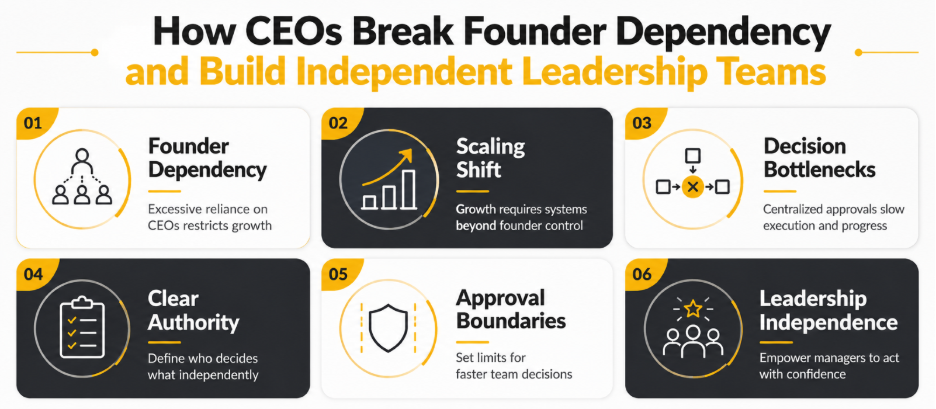
Why Founder Dependency Quietly Kills Growth?
Founder dependency rarely announces itself. It shows up as a Slack channel that never goes quiet, and a team that waits for your input before moving. In the early days, this looks like commitment. At scale, it looks like a bottleneck.
The uncomfortable truth is that founder dependency is not a people problem. It is a systems problem. When decisions live in one person’s head, the business can only grow as fast as that person can think and respond. This is exactly the gap that scaling business consulting aims to close. Success Alchemists breaks down this exact plateau in detail, and the point where fixing it stops being optional.
The Real Difference Between Growing and Scaling
Growing means more revenue, more customers, more headcount. Scaling means the business can absorb that growth without falling apart internally. A lot of CEOs confuse the two, then wonder why bigger numbers feel harder to hit, not easier.
The shift from growing to scaling almost always needs structural change, not just more effort. That is the core idea behind how CEOs reduce founder dependency.
This is also the shift that scaling business consulting supports, helping a CEO see clearly where growing stops and scaling actually begins.
Build Decision Rights Before You Build Headcount
Adding people without clarifying who decides what just creates more confusion, faster. Therefore, before hiring another layer of management, define what each role can decide without checking with you first. Budget limits, hiring approvals, and customer exceptions should all be written down.
This is one of the first steps in most scaling business consulting engagements, because unclear authority is usually the real reason growth stalls. When people know the boundaries of their own authority, they stop waiting and start acting. This single habit often does more for building a business that runs without the founder.

Install Scalable Management Systems, Not More Meetings
CEOs often respond to chaos by adding meetings. That rarely fixes anything. It just moves the confusion to a calendar. What actually helps are scalable management systems: a fixed meeting rhythm, shared scorecards, and a small number of metrics everyone tracks the same way.
Verne Harnish’s Scaling Up framework organizes this around four areas: people, strategy, execution, and cash. It treats them as the operating system of a company. Most practical scaling business consulting work starts right here, because a shared rhythm gives a leadership team a common language for decisions. Success Alchemists breaks this down further in its piece on the four decisions every CEO must get right.
Documented Playbooks Beat Institutional Memory
If a process only lives in your head, it is not a system but a single point of failure. Therefore, document how the top ten recurring decisions get made, from pricing exceptions to hiring criteria to customer escalations, so a new manager can follow the same logic you would.
This will not feel urgent until someone quits or you take a two-week trip and everything stalls. Therefore, building the documentation before that happens is far cheaper than rebuilding trust after it.
Hire and Promote for Judgment, Not Just Skill
A company that runs without daily founder input needs managers who can make sound calls without escalating every judgment call upward. That means hiring and promoting for decision-making ability, not just technical competence.
This is harder to screen for than a resume line item. That is exactly why so many CEOs skip it and pay for the gap later. It is also an area where scaling business consulting tends to add real value.
Measure the Business Through Numbers, Not Instinct
Relying on instinct might get a company off the ground, but it won’t help it scale. But a weekly scorecard with five to seven leading indicators shows what is actually happening.
When numbers replace instinct as the primary signal, a leadership team can make good decisions without waiting for the founder. A disciplined scaling business consulting process treats this scorecard as a requirement, not an option.

When Scaling Business Consulting Actually Pays for Itself?
Not every business needs outside help to fix this. But once the founder is the confirmed bottleneck on hiring, pricing, and strategy at the same time, an outside perspective tends to move faster.
Good scaling business consulting isn’t there to make decisions for you. It turns your vision into repeatable systems your team can execute. Success Alchemists lays out the signals that it is time for outside support in its guide on when a CEO should hire a certified business scaling coach, and offers a starting diagnostic through Quick Assessment.
The Bottom Line
A company that can scale without its founder is not built by working longer hours. It is built by giving away decisions on purpose, documenting how the business actually runs, and measuring performance with numbers instead of gut feel. None of this happens overnight, and it rarely happens without deliberate structure.
Ready to build a business that runs without you? Get in touch with us!
FAQs
1. What is scaling business consulting?
Scaling business consulting is a structured process that helps CEOs build the decision rights, systems, and metrics a company needs to keep growing without every action running through the founder. It usually covers four areas: people, strategy, execution, and cash.
2. How is scaling business consulting different from regular business coaching?
General business coaching often focuses on the founder’s personal effectiveness. Scaling business consulting for CEOs goes further, working on the organization itself, including decision rights, meeting rhythms, and documented processes that outlast any one person.
3. How do CEOs reduce founder dependency without losing control of the company?
Control shifts from personal involvement to system design. A CEO who reduces founder dependency defines clear decision boundaries for each role, then reviews outcomes through a scorecard instead of approving every step personally.
4. What are scalable management systems, in plain terms?
Scalable management systems are the repeatable habits that keep a growing company aligned: a fixed cadence of meetings, a small set of shared metrics, and written processes for the decisions that come up again and again.
5. At what stage does a company usually need to formalize these systems?
There is no single headcount that triggers it. The clearer signal is when a founder can no longer personally track every decision in progress. For many companies, that shows up as the team grows past a few dozen people, though the exact point varies by industry and complexity.