

Share This Article
Every January, a familiar ritual plays out in boardrooms. Leadership teams spend two or three days at an offsite. They debate the market. They argue about priorities. They leave with a clean slide deck and a shared sense of direction.
Then February happens.
Inboxes fill up. Customer fires need putting out. The annual plan quietly slides into a shared drive. Nobody opens it again until next year’s offsite rolls around. This is the exact gap business strategy consulting works on. Not the thinking behind the plan; what happens to it once the offsite ends.
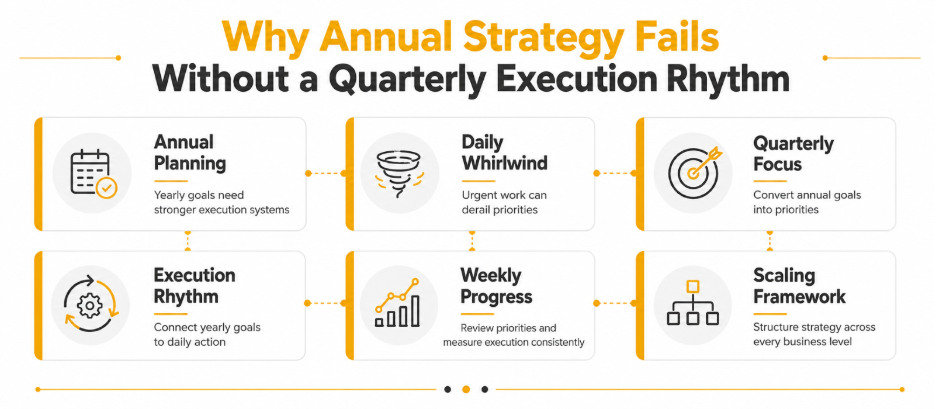
The real problem usually isn’t the strategy; it’s the missing rhythm underneath it.
Why a Once-a-Year Plan Can’t Run a Business?
An annual strategy sets direction for twelve months. However, a business doesn’t operate in twelve-month blocks. It operates in days and weeks. Customers call today. A competitor moves this month. Cash gets tight this quarter.
Sean Covey and his co-writers at FranklinCovey call this daily pull “the whirlwind” — the urgent operational noise that swallows anything not actively defended. Their research on execution, published in The 4 Disciplines of Execution, found something simple. Teams need a small number of goals. Those goals need a visible scoreboard, reviewed on a fixed weekly cadence. Otherwise, the whirlwind wins by default.
That’s the core idea behind strategy execution for scaling companies. It’s the gap between what leadership decided in January and what actually happens on the floor in March.
Building the Bridge: From Year to Quarter to Week
The fix isn’t complicated. It does need discipline, though. CEOs who get this right build a cascading rhythm with four layers:
- Annual – three to five priorities for the year, tied to a long-term goal
- Quarterly – the handful of “must-win” priorities for the next 90 days
- Weekly – specific actions, named owners, and numbers reviewed every week
- Daily – a short huddle to flag blockers before they cost a full week
This structure isn’t new. It’s one of the first things experienced business strategy consulting brings to a leadership team. Verne Harnish described an early version of it in his work on the Rockefeller Habits decades ago. It still forms the backbone of the Scaling Up methodology many growth-stage companies use today. The model rests on four decision areas: people, strategy, execution, and cash. For the full mechanics of how they connect, we break down the Scaling Up framework in more detail.
The weekly layer is where most companies fall short. Quarterly priorities get set with real energy. Then the actual Monday-to-Friday work quietly drifts.

What a CEO’s Weekly Rhythm Actually Looks Like?
A working rhythm doesn’t need to be elaborate. It needs to be consistent. In practice, it usually includes:
- A short leadership meeting, same day and time every week, reviewing a scorecard of five to seven numbers.
- One or two lead measures for each quarterly priority, alongside the lag measure (the outcome) it’s meant to predict. That distinction goes back to Robert Kaplan and David Norton, who built it into the Balanced Scorecard model in the early 1990s. It still holds up well today.
- Named owners, not departments, against every open item on the list.
- A visible red-yellow-green status on each priority, so problems surface in week three instead of month three.
For a closer look at how this structure gets built stage by stage, the strategic planning process for scaling companies covers the full sequence. It runs from annual goals down to weekly review. Much of what business strategy consulting actually delivers.
Turning Business Strategy Into Action Without Becoming the Bottleneck
Here’s where many founders trip. They build the rhythm, then insert themselves into every decision inside it. However, the weekly meeting gradually becomes a status report for the CEO.
Turning business strategy into action means the CEO’s own job has to shift. Instead of solving every problem personally, the CEO protects the calendar slot, asks the hard questions, and makes decisions happen in the room. A simple RACI structure — who’s Responsible, Accountable, Consulted, and Informed — keeps that from collapsing back onto one desk. Good business strategy consulting treats this handover as part of the work.
This shift is what separates founders who scale from founders who stay the bottleneck in their own company. We have written in detail about how founders scale a business without becoming the bottleneck.
Where Business Strategy Consulting Fits In?
Most leadership teams don’t struggle to write a strategy. They struggle to hold themselves to the rhythm that makes it real, week after week. That gets harder once the calendar fills up, when skipping a review meeting starts to feel harmless.
This is the actual value good business strategy consulting for CEOs provides. Not a better slide deck, but an outside structure that keeps the weekly cadence running. A capable advisor sits in the room, checks the scorecard against reality, and asks the question nobody on the payroll wants to ask out loud.
Ready to install that outside structure? Get in touch with us!
FAQs
1. What is a CEO operating rhythm?
A CEO operating rhythm is a fixed schedule of meetings and reviews — daily, weekly, quarterly, and annual — that connects big strategic goals to the actual work happening each week. It’s the mechanism that keeps a strategy alive between planning sessions.
2. How is a weekly execution rhythm different from a regular status meeting?
A status meeting usually reports what already happened. A weekly execution rhythm is forward-looking: it reviews a small scorecard, flags what’s off track early, and assigns clear owners to fix it before the quarter ends.
3. What’s the real difference between annual strategy and quarterly priorities?
Annual strategy sets the direction for the year — usually three to five big priorities. Quarterly priorities break that direction into a small number of “must-win” items the team can realistically finish in 90 days.
4. How many priorities should a leadership team track in a single quarter?
Most execution frameworks recommend no more than three to five quarterly priorities. Beyond that number, teams lose focus, and lead measures get harder to track consistently.
5. What metrics belong on a weekly leadership scorecard?
A useful scorecard mixes lead measures (predictive, controllable numbers, like sales calls made) with lag measures (outcomes, like revenue closed). Five to seven numbers is usually enough to see a business clearly without drowning the meeting in data.