

Share This Article
As companies scale, the challenge is no longer simply making decisions. It’s keeping the leadership team aligned around decisions. Video calls help teams stay connected. However, they don’t always create conversations that reshape strategy.
That’s why many of the fastest-growing companies combine regular coaching with intentional in-person planning sessions. So, the question isn’t whether online coaching or in-person coaching is better. The real question is how each contributes to helping leaders scale with clarity, accountability, and execution.
Let’s cut through the noise and look at what really makes a difference for founders and CEOs.
The Landscape Has Changed Permanently
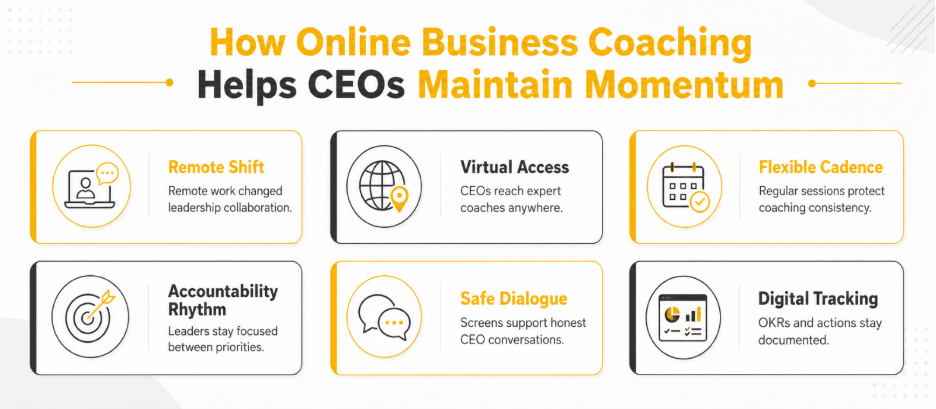
Remote work changed how businesses collaborate, but it didn’t fundamentally change how leadership teams align.
Virtual coaching has become an effective way for CEOs to stay accountable, work through decisions, and maintain momentum between strategic planning cycles. However, some of the most important conversations in a growing company don’t happen during routine check-ins.
They happen when leaders step away from daily operations, challenge assumptions, debate priorities, and collectively decide what matters most for the next quarter.
That’s why the Rockefeller Habits place such a huge emphasis on Quarterly Planning sessions. It creates the space for teams to pause, reflect, and realign before execution begins.
That said, dismissing virtual coaching would be equally shortsighted.
Where Online Coaching Creates Momentum?
The term “online business coach” sometimes gets unfairly filed under the category of “webinars and worksheets.” In reality, a high-caliber online business coach working with a CEO operates at a completely different level. Here’s what that looks like in practice:
Access to the right expertise, not just the nearest expert. Geography no longer restricts your talent pool. A CEO in Mumbai can work with a Scaling Up certified coach in Pune whose track record spans $2 billion in cumulative client turnover, without either party sacrificing two hours to traffic. When the expertise is right, the format becomes secondary.
Cadence and consistency without calendar chaos. CEOs don’t have slack time. Therefore, bi-weekly 60-minute sessions with a coach via video call are far easier to protect in your schedule than commuting to an office. Besides, consistency is everything in coaching. A steady, year-long partnership will always deliver more value than an intensive in-person engagement that gets disrupted.
A safe space with a slight distance. This is underappreciated. Many senior leaders find it slightly easier to speak candidly about board tensions or strategic anxiety when the conversation is on screen rather than across a table. The slight psychological distance of a screen can paradoxically create emotional safety.
Documentation and reflection built in. Online business coaching sessions are easier to record (with consent), easier to revisit, and easier to integrate with shared digital workspaces where your leadership team tracks OKRs, quarterly priorities, and accountability metrics.
For leaders actively scaling their organizations, online business coaching services offer the kind of operational flexibility that matches the pace of modern business.
Why In-Person Coaching Changes the Quality of Decisions?
There is a reason why scaling companies still invest in quarterly offsites even when they collaborate virtually every week.
When leaders are physically together, conversations become deeper, difficult issues surface faster, and strategic trade-offs get debated in real time. The room creates a level of focus that is hard to replicate through screens.
That’s why quarterly alignment meetings are non-negotiable in the Rockefeller framework. During these sessions, leadership teams:
- Review what’s working and what’s not.
- Challenge assumptions.
- Debate strategic priorities.
- Resolve leadership tensions.
- Align around the next 90 days.
A few days of focused alignment can prevent months of confusion, rework, and competing priorities.

The Best CEOs Don’t Replace Offsites. They Build Around Them.
The highest-impact coaching relationships are rarely purely virtual or purely in person. They use in-person planning as the anchor and virtual coaching as the support system.
A practical model often looks like this:
- Quarterly in-person planning sessions with the leadership team to revisit strategy, challenge assumptions, and align on the next 90 days.
- Bi-weekly virtual CEO coaching sessions focused on accountability, decision support, and execution.
- Weekly or monthly virtual leadership reviews to track progress against quarterly priorities.
- On-demand coaching access for time-sensitive decisions between meetings.
Virtual conversations maintain momentum, while in-person sessions create alignment.
ROI Framing: What CEOs Should Actually Measure
Whether you choose an online business coaching, an in-person coach, or a hybrid model, your ROI framework should include:
Clarity ROI: Has your strategic focus sharpened? Are fewer decisions being escalated to you? Is your leadership team operating with more alignment?
Time ROI: Is your coaching relationship saving you time by improving decision speed, reducing rework, and simplifying your organizational model?
Revenue ROI: Are the growth initiatives your coach is helping you develop translating into measurable revenue acceleration?
People ROI: Is leadership capability improving across your organization? Are you retaining top talent at higher rates?
A genuine business coach for CEOs should be comfortable being measured against metrics like these. If your coach can’t articulate how their work connects to your top-line growth or operational efficiency, that’s a signal worth paying attention to.
If you want a quick way to assess where your business stands across People, Strategy, Execution, and Cash, our free Quick Assessment gives you a clear starting point.
Final Thoughts
Online business coaching is an excellent tool for maintaining momentum. It helps CEOs stay accountable, make decisions faster, and keep execution moving between planning cycles. But momentum alone doesn’t build great companies.
The strongest leadership teams are built through intentional rhythms that bring people together to think, debate, reflect, and commit to a shared direction. Therefore:
- Virtual conversations keep the business moving.
- Quarterly offsites move the business forward.
Great teams don’t happen by accident. They are built through intentional rhythms, honest conversations, and the discipline to pause, reflect, and realign before the next quarter begins.
Ready to build a leadership team that scales together? Connect with Success Alchemists to discover how our online business coaching, Quarterly Offsites, and Scaling Up methodology can help your business grow.
FAQs
1. Is online business coaching effective for CEOs?
Yes. Online business coaching is highly effective for maintaining accountability, working through leadership challenges, and keeping execution on track between strategic planning sessions.
2. Why is in-person business coaching still important?
In-person coaching creates an environment where leadership teams can have deeper conversations, challenge assumptions, resolve conflicts, and align around strategic priorities. These discussions often lead to stronger decision-making than routine virtual meetings.
3. What are Rockefeller’s Meeting Rhythms?
Rockefeller’s Meeting Rhythms, introduced through the Scali ng Up framework, are a structured system of daily, weekly, monthly, quarterly, and annual meetings designed to improve communication, alignment, accountability, and business execution.
4. Why are Quarterly Planning sessions valuable for growing businesses?
Quarterly Planning sessions give leadership teams dedicated time to review progress, identify challenges, debate priorities, and align on the next 90 days. This focused planning helps reduce confusion, rework, and competing priorities.
5. Should CEOs choose online coaching or in-person coaching?
The most effective approach is often a combination of both. Online coaching supports ongoing execution and accountability, while in-person coaching strengthens leadership alignment and strategic decision-making.