

Share This Article
Most founders don’t notice the shift right away. Revenue keeps climbing. The team keeps growing. But somewhere along the way, you become the bottleneck in your own company. Every big decision routes through you. Every fire needs your hands on it. Your calendar is full, yet the business barely moves without your direct involvement.
This is the founder-led growth ceiling, and good CEO coaching services in Pune are built specifically for this stage. Not to give you more hours in the day. But to rebuild how decisions, accountability, and cash flow actually work inside your business.
In this blog, we’ll look at what founder-led growth actually breaks and what to expect from a coaching engagement.
The Founder-Led Growth Ceiling: What It Actually Looks Like
Founder-led growth works brilliantly in the premature years. You know every client. You close every deal. Your instincts are usually right, and speed matters more than process.
Then the company crosses a certain size. Those same instincts start to backfire.
A few signs are easy to spot once you know what to look for:
- You’re still approving expenses that a manager two levels below you should own.
- Your best salesperson routes every large deal through you before closing it.
- Senior hires you brought in for their expertise keep waiting on your sign-off.
- Cash flow surprises you, even though revenue looks healthy on paper.
- Culture starts to fragment because decisions no longer travel consistently across teams.
None of this means you’re a bad leader. It means the systems around you haven’t caught up with the size of the business you’ve built. A structured growth framework built around people, strategy, execution, and cash gives you a way to close that gap.
Coaching Is Not Consulting, and the Difference Matters
Here’s where founders often get confused. A consultant studies your business, hands you a report, and leaves. A coach stays in the room.
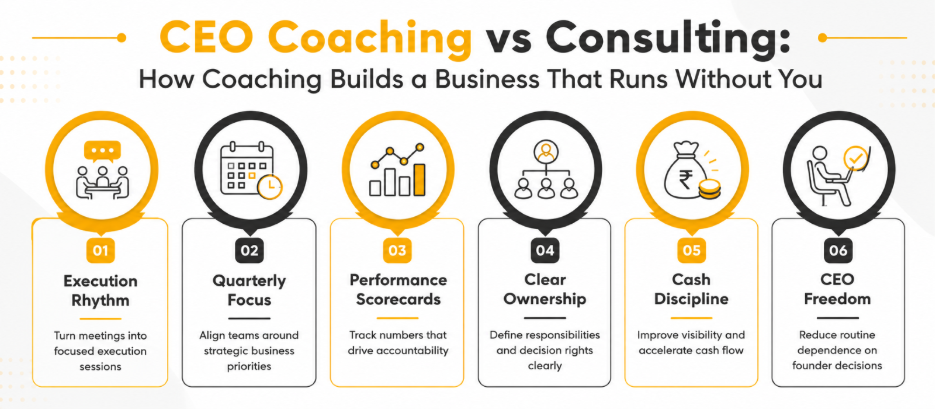
An experienced executive coach in Pune doesn’t hand you a strategy deck and disappear. They install weekly team huddles, quarterly planning sessions, and a small set of numbers you track relentlessly. They hold you accountable to decisions you made three weeks ago, not just the ones you’re making today.
This is where specific tools matter more. For example, a Function Accountability Chart forces clarity on who actually owns what. A One-Page Strategic Plan keeps your whole leadership team pointed at the same three or four priorities. And cash acceleration tools might reveal that impressive revenue numbers can easily mask a severe cash flow problem.
What to Look for in a Coach?
Not every coach fits a founder at this stage. A few things worth checking before you commit:
- Operating experience, not just certification. Has this person actually run or scaled a company, not only advised one from the sidelines?
- A repeatable framework, not ad hoc advice sessions. You want a system your team can follow, not just private conversations with you.
- Willingness to work with your leadership team, not just you. A leadership coach in Pune who only ever meets the CEO is solving half the problem, since the other half lives in how your managers make decisions day to day.
- Honest diagnostics before commitments. A serious engagement usually starts with an assessment of where your business actually stands. Tools like a Scaling Up readiness assessment give you a data-backed starting point.

What Realistically Changes, and When?
Founders often expect instant transformation. That’s not how this works, and any coach who promises it should raise a flag.
In the first 90 days, most of the work is diagnostic. You’ll map who owns what, lock down your numbers, and build your first real meeting rhythm. Around the six-month mark, decisions eventually start moving without you. You stop being the default approver for routine calls.
By the one-year mark, founders who stick with the process usually report something simpler than “growth.” They get hours of their week back. In one published example from the Success Alchemists client stories, a founder described reclaiming close to 18 hours a week once weekly reviews and clear ownership replaced constant firefighting.
Although that’s not a universal guarantee, results vary by business and by how consistently the framework gets used. But it’s an honest picture of what structured coaching aims for.
Where to Start
If your company has outgrown your ability to personally run every part of it, that’s not a failure. It’s a milestone. The founders who scale past it are the ones who bring in structure early, before burnout or a bad quarter forces the decision.
A conversation with a CEO coach in Pune costs you nothing but time. It usually clarifies more in an hour than another few months of guessing ever will.
FAQs
1. What’s the real difference between CEO coaching services in Pune and management consulting?
A consultant typically studies your business from the outside and hands you a report. A coach works alongside you for months and holds you accountable to actually executing what you agreed on.
2. How do I know if I need a CEO coach, or if I just need to hire better managers?
If you’ve already hired capable managers and decisions still funnel through you, that’s usually an accountability and ownership problem, not a talent problem. Coaching fixes the structure; hiring alone rarely does.
3. What does CEO coaching typically cost in Pune?
Pricing isn’t standardized across the industry. It depends on company size, coach experience, and engagement length. As a reference point, Success Alchemists prices its initial Scaling Up diagnostic assessment at ₹25,000 plus GST, which is separate from ongoing coaching fees.
4. How long does a typical coaching engagement run?
Most structured engagements run in quarterly cycles over 12 to 24 months. Building new decision-making habits and accountability systems takes longer than a single workshop.
5. Is CEO coaching useful for early-stage founders, or only for bigger companies?
It matters most once a founder can no longer personally track every decision, which often happens once headcount grows past roughly 25 to 40 people. This varies by industry and business model.