

Share This Article
Most leadership teams don’t lack ambition. They lack a shared picture of where they’re headed.
Ask five people on the same executive team to name the company’s top three priorities this quarter. In many companies, you’ll get five different answers. Not because anyone is careless. It’s because the strategy lives in the CEO’s head, or in a forty-slide deck nobody opens after the annual offsite.
This is the exact problem the one-page strategic plan was built to solve.
What Is a One-Page Strategic Plan?
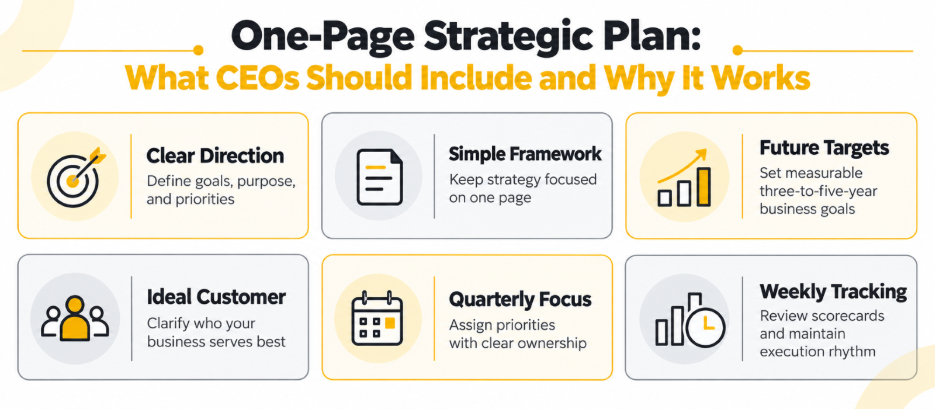
A one-page strategic plan is a single document that captures a company’s direction: its long-term goals, its target customer, its three-to-five-year targets, and what has to happen this quarter to stay on track. No filler. No forty slides. Just the handful of decisions that actually drive the business.
The concept traces back to Verne Harnish’s Mastering the Rockefeller Habits, later expanded in his book Scaling Up. It became one of the most widely used tools among growth-stage companies for one simple reason: a page people actually read beats a plan people quietly ignore. If you want to see what the full one-page strategic plan for CEOs looks like in practice, it’s worth studying the template section by section.

Why Most Strategic Plans Fail to Align a Leadership Team?
Here’s the pattern that repeats across growing companies. The leadership team spends two or three days at an offsite. They debate, they align, they leave energized. Six weeks later, everyone is back to firefighting, and the plan sits untouched in a shared drive.
The failure usually isn’t the thinking. It’s the format. A long document is hard to hold in memory, harder to revisit weekly, and nearly impossible to cascade down to a frontline manager. Therefore, a proper CEO strategic planning process has to produce something a department head can glance at and know exactly what matters this week.
That gap between having a strategy and living it daily is where growth quietly stalls. A structured planning process that connects the annual plan to weekly execution is what actually closes that gap.
What Goes on the Page?
A one-page strategic plan usually covers a few connected layers:
- Core values and purpose. The non-negotiables that shape hiring, firing, and hard calls.
- Three-to-five-year targets. Where revenue, profit, and market position need to sit by a set date.
- The target customer and “sweet spot.” Who you serve best, and why they choose you over anyone else.
- Key capabilities. The two or three moves the company must get right to reach its targets.
- Quarterly priorities. Three to five outcomes, each with one named owner, due in the next ninety days.
- A short scorecard. A handful of numbers the leadership team checks weekly, not quarterly.
How the One Page Creates Leadership Team Alignment?
Alignment doesn’t come from everyone agreeing in a room once a year. It comes from everyone looking at the same page every week and knowing how their work connects to it.
When quarterly priorities have a single owner and a visible scorecard, ambiguity disappears fast. As a result, nobody has to wonder who’s accountable for a missed number. This kind of clarity is also central to building a genuine leadership team. A strong plan means little if the people executing it aren’t the right people in the right seats.
Many CEOs bring in a strategic planning consultant to run this exercise, and there’s a practical reason for it. An internal facilitator, even the CEO, tends to steer the conversation toward familiar answers. However, an outside strategic planning consultant asks the uncomfortable questions nobody on the inside wants to raise and keeps the room honest about which priorities actually matter most.
The CEO’s Role vs. the Team’s Role
A one-page strategic plan built solely by the CEO and handed down rarely sticks. It becomes another directive to nod along with, not a plan the team owns.
The stronger approach: the CEO sets the boundaries — the values, the long-term ambition — and the leadership team fills in the rest together, in the same room, in one sitting. That’s usually where a strategic planning consultant earns their keep. They keep the debate moving, prevent one loud voice from dominating, and make sure the final page reflects real consensus, not just what the CEO wanted to hear.
Keeping the Plan Alive
A one-page strategic plan dies the same way a gym membership does: through neglect.
The fix is a rhythm. Quarterly priorities get revisited every ninety days. A short weekly meeting checks the scorecard and clears obstacles. This cadence, borrowed from the broader Scaling Up framework, is what separates companies that plan well from companies that execute consistently.
Common Mistakes to Avoid
- Too many priorities. Five is workable. Fifteen means nothing is truly urgent.
- No single owner. A goal owned by “the team” is a goal owned by no one.
- Built once, never revisited. A plan reviewed only annually stops guiding decisions by March.
- Written by the CEO alone. Buy-in comes from building it together, not receiving it.
The Bottom Line for CEOs
A one-page strategic plan won’t fix a company on its own. It forces leadership to put their top priorities in writing, then actually revisit them often enough to guide real decisions.
If your leadership team can’t answer “What are our top three priorities this quarter?” the same way, that’s usually the first sign it’s time to sit down and build one properly.
Ready to get your team aligned? Get in touch with us!
FAQs
1. What is a one-page strategic plan?
It’s a single document that captures a company’s core values, long-term targets, target customer, and current quarter’s priorities, replacing a lengthy strategy deck with something a team can actually use week to week.
2. Who created the one-page strategic plan concept?
It comes from Verne Harnish’s book Mastering the Rockefeller Habits, later built into his broader Scaling Up methodology for growth-stage companies.
3. Why do CEOs hire a strategic planning consultant instead of building the plan alone?
A consultant brings an outside perspective, keeps the workshop focused, and asks hard questions an internal facilitator often avoids raising with their own boss or peers.
4. How often should a one-page strategic plan be updated?
The long-term sections change rarely, but quarterly priorities should be revisited every ninety days, with a lighter weekly check on the scorecard.
5. How is a one-page plan different from a traditional strategic plan?
A traditional plan can run dozens of pages and gets filed away after the offsite. A one-page plan fits on a single sheet specifically so it gets reopened weekly, not just annually.