

Share This Article
Six months into a coaching engagement, most CEOs quietly ask: Is this actually working?
It’s a fair question to ask. Coaching invoices are easy to see. The return is not. Unlike a marketing campaign or a new hire, coaching rarely shows up as a single line on your P&L. That doesn’t mean it has no value. It means you’re looking for it in the wrong place.
If you’re weighing business coaching for growing companies, the goal isn’t to chase one perfect number. It’s to build a small set of indicators that tell you, quarter after quarter, whether the investment is paying off. Here’s how to do that properly.
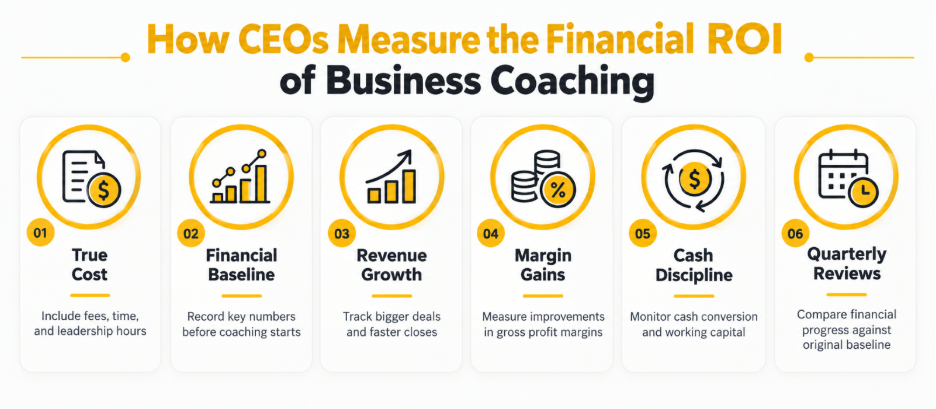
Why Coaching ROI Doesn’t Show Up on a Spreadsheet?
A coach doesn’t sell you a product. A coach changes how you think, decide, and lead a team. Those shifts ripple through the business slowly. A better hiring decision this quarter might save six figures next year. A faster call in a leadership meeting might save two weeks on a product launch.
None of that appears as “coaching revenue” anywhere. So CEOs who look only for a direct dollar-for-dollar return often give up on measuring coaching at all. That’s the wrong move. Business coaching ROI for CEOs is measurable. You just have to look in the right places.
Start With the Real Cost, Not Just the Invoice
Before you calculate a return, get the cost right. Add the coaching fees, the hours your leadership team spends in sessions, and the time spent on prep and follow-through. A coaching engagement that pulls four executives out of the business for six hours a month costs more than the invoice suggests. Factor that in, or your ROI math will flatter the program.
Set Baseline Numbers Before Day One
You cannot measure a change you never recorded. Before the first session, write down where things stand today: revenue per employee, gross margin, cash conversion days, leadership turnover, and how long major decisions currently take to close.
This one step is how to measure executive coaching results without guessing later. Most CEOs skip it. Six months in, they’re relying on memory and gut feeling, and gut feeling makes a poor scorecard.
Track ROI Across Four Buckets, Not One
Coaching ROI rarely lands as a single number. It shows up spread across four areas.
- Revenue and margin. Are you closing bigger deals, or the same deals faster? Has gross margin moved because pricing or cost decisions got sharper?
- Cash. Scaling businesses usually die from cash flow, not bad concepts. Get a solid baseline on your cash conversion cycle before coaching starts, then revisit the numbers every three months.
- Decision speed. Count how many decisions still route through you personally after three and six months. A falling number is a real, early signal.
- Leadership bench strength. Watch retention among your top ten leaders and how many calls your team makes without you. This is often the clearest, earliest sign coaching is working.
Separate Leading Indicators From Lagging Ones
Revenue and margin are lagging indicators. They move last, and slowly. However, decision speed and leadership confidence move first. So if you only watch revenue, you’ll wait a full year for a signal that was already visible after ninety days.
Therefore, watch the leading indicators monthly and the lagging ones quarterly. That combination gives you an honest, early read.

Build a 90-Day Review, Then Repeat It Quarterly.
At the ninety-day mark, sit down with your coach and your leadership team. Compare current numbers against your baseline. Ask a blunt question: What changed, and can we point to why it changed? Then repeat this review every quarter. One check-in tells you almost nothing. But a pattern across four quarters tells you nearly everything.
What Changes for Mid-Sized Companies?
Business coaching for mid-sized companies needs a slightly different lens. At this stage, the real question isn’t “did we grow?” It’s “did we grow without breaking something?” Watch whether your systems, your management layer, and your cash position can absorb the growth you’re chasing.
A company that doubles revenue while its leaders quietly burn out has not banked a real return. This breakdown of how CEOs scale a business from ₹50Cr to ₹200Cr walks through what that transition actually demands operationally.
Three Mistakes That Wreck the Measurement
- First, measuring too soon. Real behavior change across a leadership team rarely shows up before ninety days.
- Second, measuring only revenue. You’ll miss the decision-speed and retention gains that usually arrive first, months before the topline does.
- Third, skipping the baseline entirely. Without a starting point, every result feels good, and none of them can be proven.
What Strong CEO Coaching Outcomes Actually Look Like?
Solid CEO coaching outcomes tend to share a pattern.
- Meetings get shorter, and decisions actually get made inside them.
- Fewer things sit waiting on your calendar.
- Your leadership team starts disagreeing with you in the room instead of quietly ignoring you.
- Cash stops surprising you at month-end.
None of that is dramatic on its own. It’s cumulative, and that’s why a ninety-day review matters more than any single metric ever will.
Still deciding if coaching is worth the investment? This closer look at CEO coaching outcomes from real engagements is worth reading first. And before you commit budget, this breakdown of what a coaching program should include is a quick, useful read.
The Bottom Line
Coaching ROI isn’t invisible. It’s distributed across places: decision speed, cash discipline, and how much the business still leans on you personally. Track those four buckets against a real baseline and review them every quarter.
Treat business coaching for growing companies as a discipline, not a leap of faith. By the second review, the “is this working” question tends to answer itself. If you’re ready to put that structure in place, join other scaling founders at our Basecamp workshop.
FAQs
1. What is a realistic timeframe to see ROI from business coaching?
Give it ninety days before you expect anything measurable. Decision speed and leadership behavior tend to shift first. Revenue and margin usually take two to three quarters to catch up.
2. How do CEOs measure business coaching ROI without a P&L line item for it?
Track it across proxies instead: decision turnaround time, leadership retention, cash conversion days, and margin movement. None of these say “coaching” on them, but all of them move because of it.
3. What metrics best show how to measure executive coaching results?
Start with a baseline for revenue per employee, gross margin, cash conversion cycle, and time-to-decision. Recheck each one every quarter and compare against where you started.
4. Does business coaching for mid-sized companies show ROI differently than for startups?
Yes. Early-stage founders usually measure ROI through growth speed. Mid-sized companies should measure it through whether growth holds up without breaking systems, cash, or the leadership team.
5. What are the most common CEO coaching outcomes CEOs should expect?
Shorter meetings, fewer decisions stuck waiting on the CEO, a leadership team that pushes back constructively, and fewer cash surprises at month-end.