

Share This Article
Most CEOs don’t lose growth because the market turns against them. They lose it because the company outgrows the systems, habits, and decision-making style that got it this far. Revenue keeps climbing for a while. Then meetings multiply, decisions slow down, and the founder ends up back in the weeds, fixing problems a ₹5Cr business could have absorbed but a ₹50Cr business cannot.
This is exactly where business scale coaching earns its place. It isn’t generic motivation or a slide deck of best practices. It’s a structured, accountable process that helps a CEO rebuild how the company runs.
Below is a practical 90-day roadmap that shows what this work looks like in real terms.
What Business Scale Coaching Actually Changes?
A good coaching engagement doesn’t hand a CEO more tasks. It removes the ones that shouldn’t sit on their desk anymore. The coach’s job is to expose where the founder’s personal bandwidth has become the ceiling on the company’s growth, then build the structures — leadership rhythms, delegation frameworks, financial visibility — that raise that ceiling.
This matters because most CEOs already know, at some level, that something is broken. What they lack is a sequenced plan and someone outside the business who will hold them to it. That’s the real value of business scale coaching.
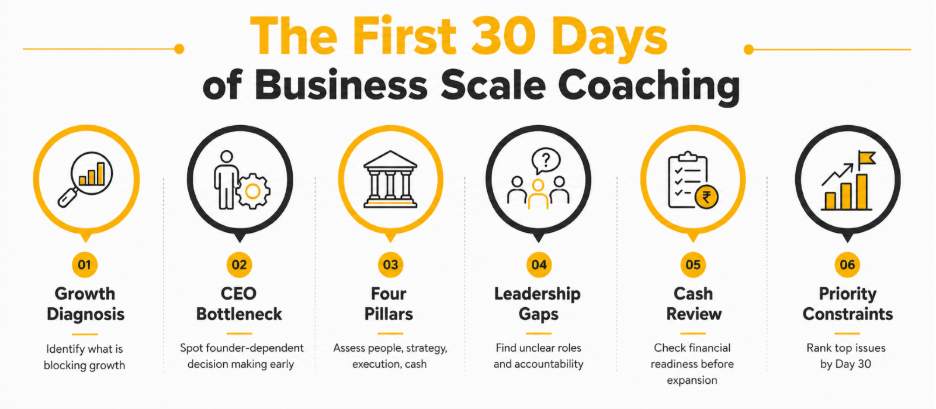
Days 1–30: Diagnose Before You Fix Anything
The first month is not about action. It’s about honesty. A coach typically runs a full assessment of the four pillars of the business — people, strategy, execution, and cash — to find out where the actual constraint lives.
This is also the point where warning signs get named out loud: falling accountability, unclear roles, a leadership team that still waits on the founder for every call. If any of that sounds familiar, it’s worth reading through the signs your company is not ready to scale, since most CEOs recognize at least three or four of them immediately.
Cash flow gets audited here too. Growth often hides a cash problem, and a coach will usually walk a CEO through how to avoid the cash flow traps that quietly kill growing businesses before any new hiring or expansion plan gets greenlit.
By day 30, the CEO should have a written, ranked list of the two or three constraints actually limiting growth.

Days 31–60: Build the Systems That Carry Weight
This is where a 90-day business scaling plan starts to take physical shape. The coach and CEO build the specific mechanisms that will hold the business together as it grows. It includes:
- a weekly leadership huddle
- a quarterly priorities process
- clear ownership for every function, and
- a dashboard of the numbers that actually predict trouble before it hits the bank account.
Leadership team quality gets addressed directly during this stretch. This is also the stage where hiring discipline matters most, and many coaches introduce a structured method like Topgrading to reduce mis-hires as the team expands.
For founders specifically, this phase can be uncomfortable. Business scale coaching often means letting go of decisions that used to feel like their identity. It’s a shift closer to the leadership transition every founder eventually faces on the way to becoming a CEO.
Days 61–90: Execute and Make It Stick
By the final month, the plan should be running without daily intervention from the coach. This is the test of whether the new systems actually work under pressure. Weekly rhythms either hold or they collapse the moment a real crisis shows up, and that’s usually the most honest signal of progress.
Execution gaps get closed here, not strategy gaps. Most leadership teams already know what to do; they struggle to make it happen consistently, which is why strong growth consulting focuses on execution discipline. A CEO roadmap for scaling a company only holds value if it survives contact with a busy quarter, so this phase deliberately avoids removing pressure too early.
By day 90, the goal isn’t a finished company. It’s a company that can run its new systems without the coach in the room every week.
Common Mistakes During a 90-Day Scaling Push
A few patterns show up again and again, regardless of industry:
- Treating the 90 days as a project with an end date
- Adding new strategic goals mid-process instead of finishing what’s already been started
- Skipping the cash and metrics work because it feels less urgent than people problems
- Letting the CEO quietly slide back into old habits once the pressure of week one fades
- Each of these is fixable, but only if the CEO stays honest about which one is happening to them.
Final Thoughts
Scaling a company was never going to be comfortable. But a structured 90-day plan, built on a real framework and backed by someone who won’t let the CEO off the hook, turns a vague ambition into a sequence of decisions that actually get made. That’s the difference business scale coaching is built to deliver.
Ready to turn ambition into execution? Get in touch with us!
FAQs
1. What is business scale coaching, exactly?
It’s a structured coaching process that helps CEOs rebuild how their company operates across people, strategy, execution, and cash, so growth doesn’t outpace the systems supporting it.
2. How is business scale coaching different from general business consulting?
Consulting often hands over a report and moves on. Coaching stays involved, holds the CEO accountable week to week, and adjusts the plan as real results come in.
3. Is 90 days really enough time to see results?
Ninety days is enough to diagnose the real constraints, build the core systems, and test whether they hold under pressure. Full cultural change usually takes longer, but the foundation gets laid in this window.
4. Who benefits most from business scale coaching for founders?
Founder-CEOs who are still personally involved in most decisions, especially past the ₹50Cr revenue mark, tend to see the fastest and most noticeable shift.
5. Does this only apply to fast-growing companies?
No. Companies stuck at a plateau often benefit even more, since the coaching process exposes exactly why growth has stalled.