

Share This Article
Most CEOs don’t call a strategy consulting firm on a good day. They call after three quarters of hitting revenue targets while margins quietly shrink. Or after a leadership meeting where everyone nods at the plan, then goes back to doing whatever they were already doing.
The question isn’t whether outside help would be useful. It almost always is. The real question is timing. Bring in a strategy consulting firm too early, and you pay for advice you don’t yet have the internal capacity to act on. Wait too long, and you’re paying consultants to fix a crisis that better timing could have prevented.
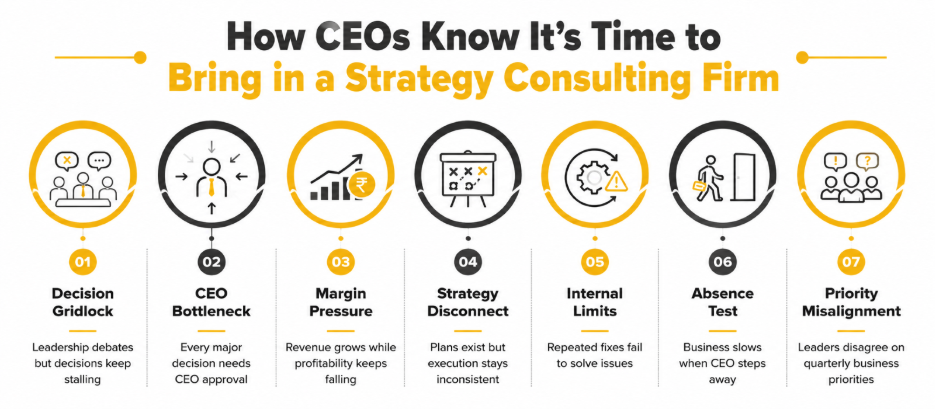
The Signals Worth Paying Attention To
A few patterns frequently show up in companies that eventually reach out to a strategy consulting firm.
The first is decision gridlock. Leadership meetings run long, everyone has an opinion, and nothing gets decided until the CEO steps in and makes the call alone. That’s not collaboration. That’s a team without a shared framework.
The second is growth that doesn’t translate into profit. Revenue climbs. Headcount climbs faster. But margins move the wrong direction, and nobody can point to exactly why. This is one of the clearest signs that strategy and execution have drifted apart. To get an in-depth analysis, you may read about the scaling challenges in mid-sized companies.
The third is a strategy document that nobody below the leadership team could recite. A strategy that stays trapped in a slide deck instead of driving weekly priorities is just a glorified wish list.
None of these problems require a strategy consulting firm on day one. Sometimes a sharper internal process solves them. But when a founder or CEO has tried the obvious fixes and the pattern persists, that’s usually the point where outside perspective starts paying for itself.

What a Strategy Consulting Firm Actually Does?
There’s a common misconception that a strategy consulting firm hands a new five-year plan and walks away. That model exists, but it’s rarely the one that produces lasting change.
The more useful version of a strategy consulting firm for CEOs works differently. It doesn’t just diagnose the problem. It sits with the leadership team long enough to understand why past plans stalled, then builds a framework the team can actually run without outside help. Good consultants leave you more capable, not more dependent.
Growth Stage Changes the Calculation
Timing for strategy consulting depends heavily on revenue stage. A company crossing from founder-led decision-making into a real leadership team faces different pressure.
Early-stage growing companies often need less formal consulting and more structured coaching around building their first real leadership layer. Mid-stage companies, where the founder is still the bottleneck for every meaningful decision, tend to benefit most from a structured outside process.
Later-stage companies facing a genuine transformation — a new market, a leadership transition, a pivot in business model — usually need the deepest engagement. This is where a strategy consulting firm brings the most measurable value, because the cost of a wrong turn is highest.
When to Hire a Strategy Consulting Firm — A Simple Test?
A useful gut check: if you removed yourself from the business for four weeks, would strategic decisions still move forward with reasonable judgment? If the honest answer is no, that’s a strong signal it’s time to look outside.
Another test — can your leadership team explain, in one sentence each, what the company’s top three priorities are this quarter? If the answers don’t match, alignment is the real problem, not talent or effort. A strategic planning process built for scaling companies addresses exactly this kind of drift between plan and daily reality.
Choosing the Right Fit, Not the Biggest Name
CEOs sometimes assume the value of a strategy consulting firm scales with its size or its client logos. In practice, fit matters more than brand. A large global firm might be right for a Fortune 500 restructuring. A mid-sized company navigating its first real scale-up often gets more value from a firm that works closely with founders and stays through implementation.
Before hiring, it’s worth running a quick internal audit of where the actual gap sits. A short assessment can surface this faster than another round of internal debate.
The Cost of Waiting
The riskiest choice a CEO can make isn’t hiring the wrong strategy consulting firm. It’s waiting so long that the same problems compound into something harder to unwind.
Companies that bring in outside strategic support before the crisis tend to see far smoother transitions. Don’t let the cost of waiting grow any larger. Partner with Success Alchemists today and get the strategic clarity your company needs!
FAQs
- What’s the difference between a strategy consulting firm and a business coach?
A strategy consulting firm typically diagnoses a specific problem and builds a plan to fix it. A business coach works more continuously with the CEO and leadership team on judgment, habits, and execution over time. Many CEOs benefit from both at different stages.
- How much does a strategy consulting firm typically cost?
Costs vary widely based on scope, firm size, and engagement length. Most firms scope pricing after an initial discovery conversation rather than quoting a flat rate upfront.
- Can a small or mid-sized company afford strategy consulting?
Yes. Strategy consulting for growing companies has become far more accessible than the traditional big-firm model, with boutique and mid-market firms designing engagements specifically for companies below ₹500 crore in revenue.
- How long does a typical strategy consulting engagement last?
Diagnostic engagements often run four to eight weeks. Full implementation support, where the firm stays through execution, commonly runs three to twelve months depending on the scope of change.
- What’s the biggest mistake CEOs make when hiring a strategy consulting firm?
Treating the engagement as a one-time deliverable rather than a change in how the leadership team operates. A plan without a follow-through mechanism rarely survives contact with daily operations.