

Share This Article
Most growth conversations in boardrooms stay dangerously surface-level. You discuss revenue targets, headcount expansion, new geographies, yet the harder question rarely gets asked: are we actually built to handle the scale we’re chasing?
The painful truth is that the majority of fast-growing companies stall not because the market dried up, but because their internal architecture couldn’t carry the weight. They ran straight into a plateau. It’s realizing the strategies that got them to ₹50 crore or $10 million actively resist getting them to the next level. Therefore, scaling up business isn’t just about ambition. It’s about building the right foundation before you try to build higher.
In this blog, we break down seven strategies that CEOs and founders who’ve actually done it rely on.
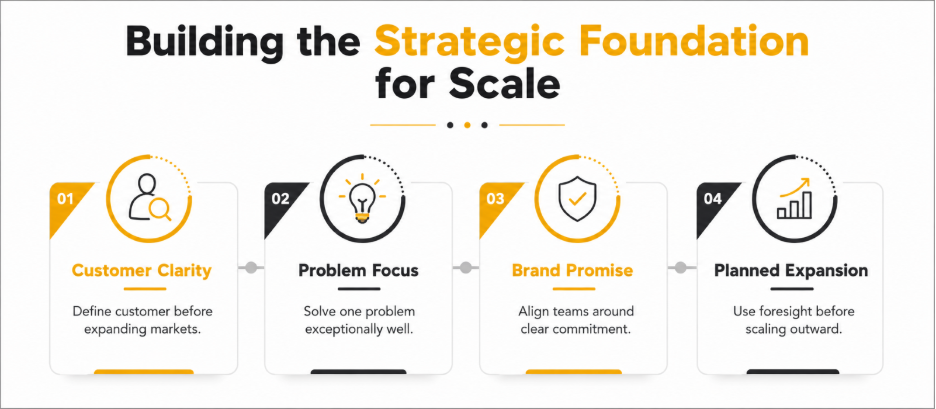
1. Nail Your Core Customer and Their #1 Problem Before You Expand Anything
Business expansion tempts leaders with more products, more markets, more customer segments. That instinct, left unchecked, is one of the fastest ways to dilute a business into mediocrity. Many CEOs who approach scaling up business this way end up with a sprawling operation that’s harder to manage.
The companies that scale well do the opposite first: they go deeper before they go wider. They obsessively define who their core customer truly is, what singular problem they solve better than anyone else, and what their Brand Promise is — the commitment they’d stake the company’s reputation on.
This isn’t a marketing exercise. It’s a strategic foundation. When your entire organisation, from sales to operations to HR, understands exactly who you serve and why, decision-making accelerates at every level.
2. Build a Leadership Team That Makes You Redundant
Here’s a question worth sitting with: if you took a three-month sabbatical tomorrow, would your business grow, plateau, or decline?
Most founders and CEOs, if honest, know the answer is uncomfortable. The business is often still running on their judgment, relationships, and energy. Simply put, scaling up is limited by how much the CEO can handle alone.
The antidote is building what Verne Harnish, author of Scaling Up, calls the Senior Leadership Team (SLT). It’s not just capable department heads but genuinely accountable, strategically aligned leaders who can run their function independently. The Function Accountability Chart (FACe) helps map every critical business function to a named leader who is both responsible and accountable.
This transition is often the single biggest unlock in any serious business growth strategy. Success Alchemists works extensively with leadership teams on precisely this shift.

3. Build a Rhythm of Execution, Not a Culture of Heroics
One of the most destructive patterns in scaling up business is what experienced coaches call “heroic execution.” It’s a few exceptional individuals who carry the weight that systems should be carrying. As a result, it creates single points of failure and burns out your best people.
In ambitious companies, you’ll find people working incredibly hard and producing results that don’t match the effort. The problem is rarely motivation. It’s the absence of an execution rhythm.
Growth strategy consulting firms often observe the same pattern: companies with strong vision and weak execution infrastructure. They have quarterly planning off-sites, but no weekly accountability cadence. They set annual goals, but no 90-day priorities. They measure outcomes, but rarely track leading indicators that would tell them in advance if they’re off track.
The Rockefeller Habits is widely used by high-growth companies to address this directly. Practices like daily huddles (15 minutes, focused on stuck points and priorities), weekly strategic conversations, and quarterly theme-setting create a cadence where priorities stay visible, and accountability becomes automatic.
4. Treat Cash Flow as a Strategic Variable, Not a Finance Function
The graveyard of scaling businesses is full of profitable companies that ran out of cash. This is not a paradox; it’s accounting, and it’s one of the most underappreciated realities of scaling up business. If you don’t manage the timing of cash flow as aggressively as you manage revenue growth, you’ll find yourself in a liquidity crisis at exactly the moment your business is performing well.
Therefore, experienced growth strategy consultants treat cash flow as a strategic input. To understand this, you need to watch how fast your cash completes a full loop from investment to collection (the Cash Conversion Cycle), and how a minor, single-unit adjustment to your core financial levers can completely shift your P&L statement (the Power of One).
CEOs who understand their Power of One can have highly specific, high-leverage conversations with their CFO about where to focus. It converts “we need to improve margins,” a vague aspiration, into “if we reduce our CCC by eight days, we free up ₹3 crore in working capital.”
Cash Acceleration Strategies (CASh) toolkit is built specifically for this kind of operational finance conversation.
5. Treat Talent Strategy as a Growth Strategy
You cannot scale up a business faster than your talent pipeline allows. This is one of the most frequently underestimated constraints in any scaling up business journey. Leaders invest in strategy and technology but neglect to build the human infrastructure that those tools require to function.
The most effective CEOs tackle this head-on with a Talent Assessment. It’s a systematic evaluation of each key role against the demands of the next growth horizon. This conversation requires honesty and care since it’s one of the highest-ROI leadership actions available.
Equally important is the One Page Personal Plan (OPPP), a tool that helps leaders connect individual aspiration to company direction. When people see how their personal growth intersects with the company’s growth, discretionary effort goes up, and attrition goes down. That’s a competitive advantage at scale.
6. Define Your Business Expansion Moves Before the Market Forces Them
In every serious scaling up business engagement, one truth surfaces consistently: most business expansion happens reactively. However, reactive expansion is expensive and distracting. On the contrary, proactive expansion is a compounding advantage.
World-class companies think three to five years ahead and pre-decide which markets, segments, or adjacencies they’ll move into and on what timeline. They don’t wait for the market to force their hand. This kind of strategic foresight is what separates companies that respond to competition from those that define the landscape.
The SWT (Strengths, Weaknesses, and Trends) analysis is particularly useful here. It asks the company to deeply understand the external trends shaping its industry over the next decade and then map its current strengths against the opportunities those trends create. The gap between current strengths and future-state requirements becomes the agenda for strategic investment.
When combined with a clearly defined One Page Strategic Plan (OPSP), business expansion becomes an organised, sequenced effort rather than a bet.
7. Measure What Moves, Not What’s Easy to Count
Many executive teams spend their weekly meetings reviewing lagging indicators. These numbers tell you what happened. They cannot tell you what’s about to happen. And when you’re scaling up a business at speed, a two-month lag in your feedback loop is the difference between a course correction and a crisis.
Scaling up a business sustainably requires building a dashboard of leading indicators. The discipline of identifying your “Critical Number” is the single most important metric at any given point. When the entire company is focused on moving one number, decision-making at every level becomes faster and more coherent.
That’s what the Basecamp Workshop is all about. |It deep-dives into strategy, execution metrics, and how CEOs shape organisational focus.
The Compounding Effect of Getting This Right
Each of these seven strategies works in isolation. But they compound when they work together. When your leadership team is accountable, your execution cadence is sharp, your cash position is actively managed, your talent is ahead of your growth curve, and your metrics are leading rather than lagging.
If you’re at an inflection point and wondering why effort isn’t translating into trajectory, the answer is almost always architectural, not motivational. Success Alchemists works with founders and CEOs at exactly this inflection. Get in touch with us!
FAQs
1. What is the difference between business growth and business scaling?
Business growth increases revenue by adding resources, while business scaling increases revenue faster than costs through better systems, processes, and leadership.
2. When should a CEO start planning to scale a business?
Start before growth slows down. The ideal time is when your business is performing well but approaching its operational limits.
3. What are the four pillars of the Scaling Up framework?
The framework focuses on People, Strategy, Execution, and Cash to help businesses achieve sustainable, profitable growth.
4. Does a business growth strategy vary by industry?
Yes. While the core principles remain the same, the strategy is tailored to the unique challenges, customers, and operations of each industry.
5. Why do businesses often fail during expansion?
Many businesses expand before building strong internal systems. Weak operations, leadership, or financial processes often become bigger problems as the business grows.